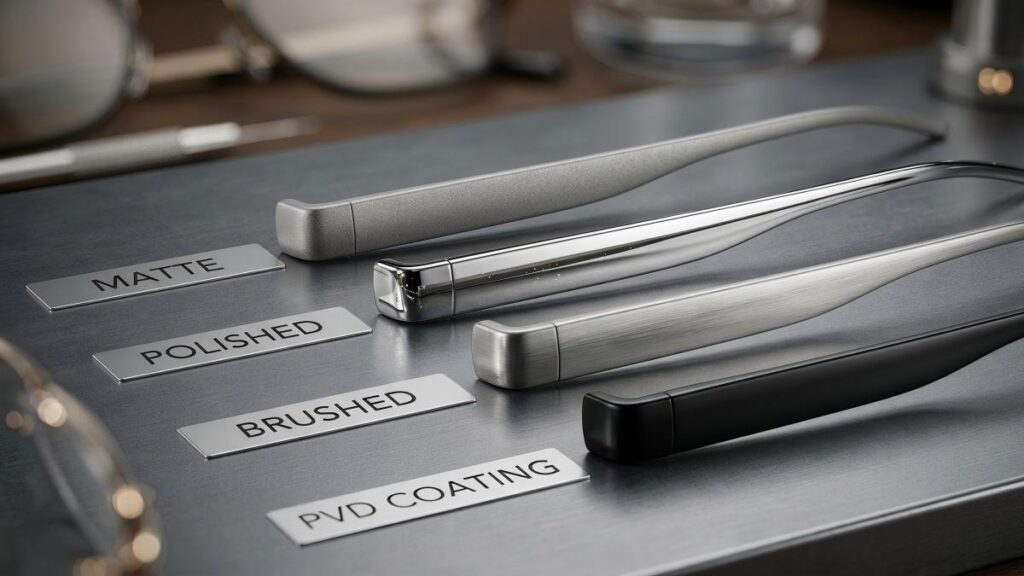
Titânio frames are available in four main finishes — matte, polished, brushed, and PVD coated — and each changes how the frame looks, feels, wears, and costs. The finish is not decoration; it is a product decision that affects your brand positioning, your customer’s daily experience, and your per-unit cost.
Choosing the right finish is as important as choosing the material itself. This guide covers each finish from a manufacturing perspective: how it is applied, what it looks like, durability, cost impact, and which collections each suits.
The Four Finishes at a Glance
| Finish | Look | Feel | Durability | Cost Impact |
|---|---|---|---|---|
| Matte | Subtle, modern, low-reflectivity | Soft, non-slip, warm | Good — hides micro-scratches | Baseline |
| Polished | Mirror-like, classic luxury | Smooth, cool, premium | Moderate — shows fingerprints | +10-15% |
| Brushed | Linear grain, refined texture | Directional, tactile | Good — hides scratches | +10-15% |
| PVD coated | Any color, including black, gold, gunmetal | Depends on base finish | Excellent — hard coating | +20-40% |
Finish 1: Matte Titanium
How it’s applied
The frame surface is blasted with fine abrasive media (aluminum oxide or glass beads) to create a uniform matte texture, then the sharp edges are removed.
Characteristics
- Low reflectivity — reduces glare in bright conditions
- Non-slip grip — the micro-texture helps the frame stay in place
- Hides wear — micro-scratches blend into the texture rather than standing out
- Modern aesthetic — reads as contemporary, understated, technical
Best for
- Sport and performance collections
- Men’s optical frames (matte black, matte grey)
- Brands positioning as “modern minimalism”
Finish 2: Polished Titanium
How it’s applied
Progressive polishing — from coarse compound to fine buffing compound on cloth or felt wheels — creates a mirror finish.
Characteristics
- Mirror reflection — the classic “premium titanium” look
- Smooth, cool feel — luxurious tactile experience
- Shows fingerprints and smudges — requires regular wiping
- Shows micro-scratches more easily than matte
Best for
- Classic, elegant, dressy optical frames
- Luxury positioning where “shiny titanium” is the story
- Collections that prioritize aesthetic over low-maintenance
Finish 3: Brushed Titanium
How it’s applied
The frame surface is passed against an abrasive belt or wheel in one direction, creating fine linear grain.
Characteristics
- Directional grain — visible texture that changes with light
- Tactile quality — feels engineered and intentional
- Hides scratches — linear scratches blend into the grain
- Premium industrial look — between matte and polished
Best for
- Unisex contemporary frames
- Rimless and semi-rimless designs (the grain adds visual interest)
- Brands wanting “engineering precision” as part of the story
Finish 4: PVD Coated Titanium
What PVD is
PVD (Physical Vapor Deposition) is a vacuum coating process: titanium atoms are vaporized and deposited onto the frame surface as a thin, hard film. It can be applied over any base finish to change or enhance color.
Popular PVD colors for titanium frames
| Color | Positioning |
|---|---|
| Black (gunmetal) | Modern, stealth, sport |
| Gold / champagne | Luxury, classic |
| Rose gold | Fashion-forward, feminine |
| Grey / titanium natural | Technical, understated |
| Blue / custom colors | Fashion statement |
Characteristics
- Extreme hardness — PVD coating is harder than the titanium itself, excellent scratch resistance
- Color stability — does not fade or discolor with wear
- Hypoallergenic — the coating is inert and biocompatible
- Uniform color — consistent across the whole frame
- Higher cost — the vacuum coating process adds significant per-unit cost
Best for
- Black titanium frames (the most requested premium color)
- Fashion-forward collections in non-traditional colors
- Frames where scratch resistance is a selling point
- Brand signature colors — PVD allows exact color matching
Finish Decision Guide
| Your Positioning | Recommended Finish | Why |
|---|---|---|
| Sport / performance | Matte or brushed | Non-slip, hides wear, technical look |
| Classic luxury | Polished | Mirror finish = traditional premium |
| Contemporary unisex | Brushed | Refined texture, hides wear |
| Modern premium | Matte black (PVD) | The current “premium black” standard |
| Fashion forward | PVD in signature color | Exact color matching, durability |
| Budget-conscious titanium | Matte natural | Lowest cost, still premium feel |
Cost Comparison
| Finish | Cost Impact Per Frame |
|---|---|
| Matte natural | Baseline (titanium frame cost) |
| Polished | +$1-2 |
| Brushed | +$1-2 |
| PVD single color | +$3-6 |
| PVD custom color match | +$5-8 |
| Two-tone / gradient PVD | +$6-10 |
At retail, these manufacturing premiums translate to roughly 3-5x in shelf price — which is why finish choice matters financially, not just aesthetically.
Frequently Asked Questions
Is PVD coating safe for sensitive skin?
Yes. PVD coating is inert and does not react with skin. It is widely used in medical devices for this reason.
Does PVD coating change the frame weight?
Negligibly. The coating is a few micrometers thick — imperceptible in weight.
Can a matte frame be re-polished?
No. Matte texture cannot be restored once damaged (re-polishing removes the texture). PVD-coated matte frames should be re-coated, not re-polished.
Which finish is most scratch-resistant?
PVD coated frames. The coating’s hardness exceeds the base titanium. Among uncoated finishes, matte hides scratches best visually, even though it is not harder.
Can I mix finishes on one frame?
Yes. Two-tone designs — polished frame front with brushed temples, or matte frame with PVD-colored accents — are common in premium collections. Specify the combination clearly in your spec.