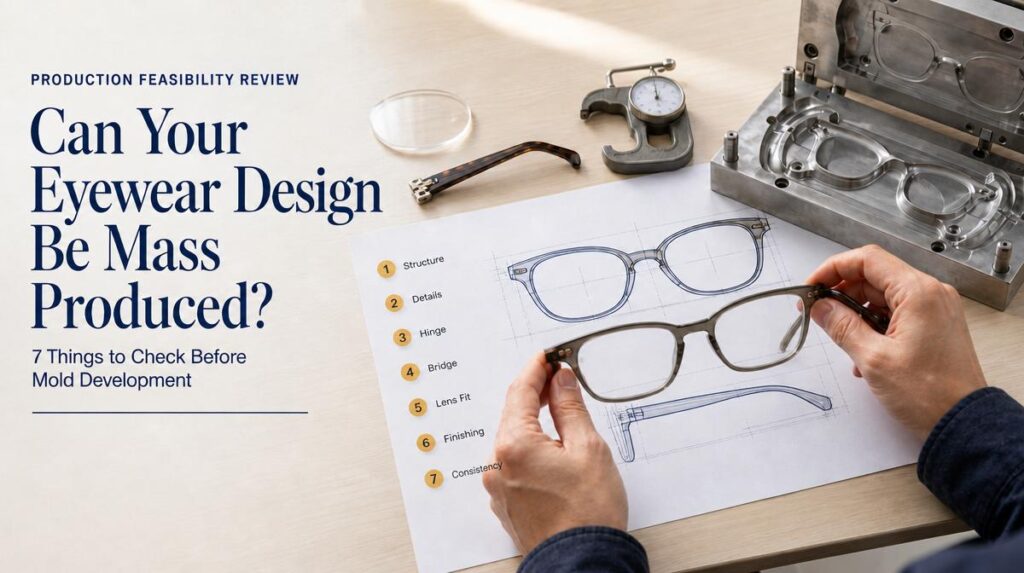
A custom eyewear design may look perfect in a sketch or 3D rendering, but that does not always mean it is ready for mass production.
Before developing a mold, brands should confirm whether the design can be manufactured consistently, assembled efficiently, and finished to the expected standard.
For Full Custom eyewear projects, an early production feasibility review can help reduce unnecessary design changes, mold revisions, and delays later in the development process.
Here are seven practical points to check before moving from design to mold development.
1. Frame Structure and Thickness
Frame thickness affects more than appearance. It can influence machining, strength, weight, and finishing.
For acetate frames, very thin sections may require structural adjustments, while overly thick areas can increase weight and affect wearing comfort.
For titanium and metal frames, wire diameter, sheet thickness, connection points, and component geometry need to work with the forming and joining processes.
Material and structure should therefore be considered together from the beginning.
If you are still deciding between acetate and titanium, see our guide on Acetate vs Titanium Eyewear: Which Material Fits Your Custom Collection?.
2. Complex Shapes and Small Details
Sculpted surfaces, sharp transitions, layered structures, and small decorative details can make a design more difficult to manufacture.
A deep 3D shape may require additional CNC machining, while very narrow sections can be difficult to machine or polish consistently.
Complex designs are not necessarily a problem. The key is understanding whether the important design elements can be reproduced efficiently without changing the intended appearance.
A production review during CAD development can help identify these issues before mold development begins.
3. Hinge and Temple Construction
The hinge area is one of the most important structural points of an eyewear frame.
There needs to be enough space for the hinge components, screws, and surrounding material, while the temple must still open and close correctly.
A visually attractive temple design may require adjustment if the hinge area is too narrow or the construction makes assembly difficult.
Checking these details before mold development can prevent unnecessary changes later.
4. Bridge, Nose Pads, and Wearing Comfort
The bridge can look simple in a drawing, but it has a direct effect on how the finished frame fits.
Brands should consider bridge width, frame height, nose pad position, and the relationship between the bridge and lens shape.
For titanium and metal frames, nose pad components and connection points also need to be incorporated into the design.
For acetate frames, the bridge needs to provide enough structure while maintaining the intended visual profile.
A physical prototype is especially useful for confirming fit and balance before mass production.
5. Lens Shape and Frame Construction
Lens geometry should be reviewed together with the frame design.
Lens shape, rim thickness, bevel position, and lens installation requirements all need to work together.
This becomes particularly important for unusual lens shapes, thin rims, deep bevels, or strongly curved designs.
A significant lens change after mold development can affect other parts of the frame and may require additional adjustments.
Early technical communication between the brand and manufacturer can help reduce this type of redesign.
6. Finishing Requirements
A frame is not finished when machining or forming is complete.
Polishing, plating, surface treatments, laser details, color effects, and logo applications can all influence the final appearance.
For acetate frames, sculpted edges and complex surfaces may require additional manual polishing.
For titanium and metal frames, joining areas and surface treatments also need to be considered during development.
If a specific finishing effect is important to the collection, it should be discussed before production rather than treated as a final-stage detail.
7. Can the Design Be Reproduced Consistently?
Making one good prototype is not the same as producing hundreds or thousands of consistent frames.
Mass production requires control over material variation, machining tolerances, assembly, polishing, hinge installation, surface finishing, and final inspection.
The important question is therefore not only:
Can this design be made?
It is also:
Can this design be made consistently at production volume?
This is closely connected to the principles discussed in Eyewear Design for Manufacturing: What Brands Should Consider Before Production.
What If the Design Is Not Production-Ready?
A design that needs adjustment does not necessarily need to be simplified or abandoned.
In many cases, the manufacturer can suggest changes to dimensions, structure, materials, or finishing methods while preserving the main visual concept.
This is one reason why production feasibility should be reviewed before mold development.
Changes made after a mold has already been completed can require additional revisions and development time.
The goal is not simply to make the design easier to manufacture. It is to find a practical balance between design intent and production requirements.
When Should You Discuss Production Feasibility?
Ideally, the discussion should happen before the final CAD is approved and before mold development begins.
A typical development path may look like:
Design concept → Material selection → Production feasibility review → CAD development → Prototype → Mold development → Mass production
The exact process can vary by project, but early technical communication usually gives the manufacturer more flexibility to suggest practical solutions.
For more detail on the next stage, see How Custom Eyewear Mold Development Works: From Your Sketch to Finished Frame.
Need a Production Feasibility Review?
If you already have sketches, reference frames, CAD files, or 3D concepts, you can discuss the design with a manufacturer before everything is finalized.
An early review can help identify potential issues with material selection, structure, components, or finishing.
Discuss Your Custom Eyewear Project
Final Checklist Before Mold Development
Before approving a custom eyewear design, check:
- Is the structure suitable for the selected material?
- Are the frame thicknesses practical?
- Can complex shapes and details be manufactured consistently?
- Is there enough space for hinges and components?
- Has bridge and nose pad construction been considered?
- Does the lens geometry work with the frame?
- Can the required finishing effects be reproduced?
- Can the design maintain consistent quality at production volume?
Final Thoughts
A successful custom eyewear project is not only about creating an attractive design. The design also needs to work as a manufacturable product.
Reviewing the frame structure, material, components, lens geometry, finishing, and production consistency before mold development can help identify potential problems earlier.
For Full Custom OEM/ODM eyewear projects, this early feasibility review creates a clearer path from concept to prototype and eventually to mass production.
Have a custom eyewear design ready?
Share your sketches, CAD files, reference images, or existing frame concepts with our team.
Start Your Custom Eyewear Project
FAQ
1. How do I know if my eyewear design can be mass produced?
A manufacturer should review the material, frame structure, thickness, hinge construction, lens geometry, finishing requirements, and production tolerances before mold development.
2. Can complex eyewear designs be manufactured?
Yes. Complex designs can often be manufactured, but they may require additional machining, manual finishing, special components, or adjustments to the original structure.
3. Should production feasibility be checked before mold development?
Yes. Reviewing the design before mold development can help identify manufacturing issues earlier and reduce unnecessary mold revisions.
4. Can a manufacturer modify my design for production?
In many cases, yes. A manufacturer can suggest practical changes to dimensions, structure, materials, or finishing while keeping the main design concept intact.
5. Why is production consistency important?
A successful prototype does not automatically guarantee consistent mass production. Material, machining, assembly, finishing, and inspection all need to be controlled throughout production.