When developing custom eyewear, brands often spend most of their time deciding on the frame shape, material, and color.
But there is another factor that can significantly change the final appearance: surface finishing.
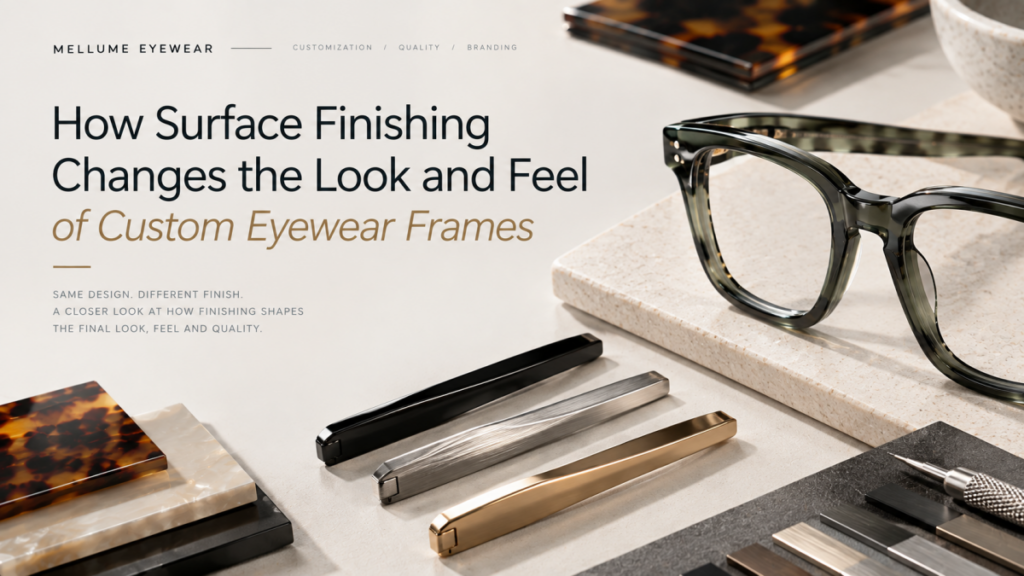
The same frame design can look completely different after polishing, brushing, tumbling, electroplating, or other finishing processes. Finishing can affect how light reflects from the frame, how smooth it feels, how clearly the material pattern appears, and even how premium or understated the final product looks.
For custom eyewear, finishing should therefore be considered part of the design rather than simply the last production step.
1. Finishing Can Change the Visual Character of a Frame
Surface finishing controls how the frame interacts with light.
A highly polished surface reflects more light and can make the frame look cleaner, brighter, and more refined. A matte or brushed surface creates less reflection and gives the frame a quieter, more technical appearance.
This difference can be especially noticeable on metal frames.
For example:
- High polish can emphasize a smooth and refined appearance
- Brushed finishes create visible directional texture
- Matte finishes reduce surface reflection
- Electroplated finishes can create different metallic appearances
- Mixed finishes can create contrast between different frame areas
The underlying frame shape may remain exactly the same, but the finishing can change how that shape is perceived.
2. Acabamento e Finishing Changes More Than Shine
Finishing is particularly important for acetate eyewear.
After CNC cutting and shaping, acetate frames can go through processes such as tumbling, edge shaping, and hand polishing.
Polishing can make the edges clearer and bring out the depth of the acetate. This can be particularly effective with transparent, marble, tortoiseshell, or layered materials.
The difference between a dull edge and a carefully polished edge may seem small during design development, but it can have a noticeable effect on the finished frame.
For brands developing acetate collections, understanding how material selection and manufacturing work together is also important. Our article on Acetate vs Titanium Eyewear explains some of the key differences between these two materials.
3. Edge Treatment Can Change the Shape of the Frame
With acetate, the edge is not simply a finishing detail.
Different edge treatments can make the frame appear:
- Thicker or thinner
- Softer or sharper
- More transparent
- More dimensional
- More sculpted
A strong bevel can create a more defined transition between surfaces, while a rounded and highly polished edge can create a softer appearance.
This is one reason why the same acetate front can look noticeably different after different finishing treatments.
For custom designs, the edge treatment should be considered together with frame thickness, bevel geometry, and the intended visual effect.
4. Metal Finishing Creates Different Surface Textures
Metal eyewear offers a different range of finishing possibilities.
Depending on the design, manufacturers may use polishing, brushing, matte treatment, or electroplating to achieve the required surface appearance.
A polished metal surface can emphasize curves and reflect light strongly.
A brushed surface creates directional lines that make the material texture more visible.
A matte finish can reduce reflections and create a more understated appearance.
These finishes can also be combined on one frame. For example, a frame may use a polished surface on one area and a brushed or matte treatment on another to create subtle contrast.
The choice should be made according to the design rather than simply selecting the most visually striking finish.
5. Finishing Can Affect How Colors Appear
Surface treatment can change how the eye perceives color.
This is particularly relevant to plated metal frames and transparent or patterned acetate.
A highly polished surface may make a color appear brighter because it reflects more light. A matte surface can make the same color appear softer and less reflective.
For acetate, polishing can also make transparent sections appear clearer and help reveal the depth of layered colors or patterns.
Therefore, a color sample should ideally be evaluated together with the intended finishing method.
Choosing the color first and deciding on finishing much later can sometimes lead to a different result from what the brand originally expected.
6. Different Finishes Create Different Tactile Experiences
Finishing is not only visual.
It also changes how a frame feels when handled.
A highly polished acetate surface feels smooth and has a different tactile quality from a lightly finished surface. Brushed or matte metal also creates a different sensation compared with highly polished metal.
For eyewear brands, this matters because customers experience the product through both sight and touch.
Small details such as smooth edges, clean transitions, and consistent surface texture can influence the perceived quality of a frame.
7. Finishing Should Work With Branding Details
Logo applications and decorative components also need to work with the surrounding surface.
For example, a laser-engraved logo may appear differently on a polished surface compared with a matte surface.
A metal logo or decorative pin can create stronger contrast when placed against a different texture or finish.
This is why branding details should not be treated separately from frame finishing.
Our guide to custom eyewear logo techniques covers options such as laser engraving, pad printing, metal logos, and decorative details.
8. Finishing Requirements Should Be Defined Before Production
One common mistake is to describe a finish using only general terms such as “shiny,” “matte,” or “premium.”
These descriptions may not be specific enough for production.
When communicating with a factory, brands should provide clear references whenever possible.
Useful information can include:
- Reference samples
- Surface finish images
- Material samples
- Color references
- Areas requiring different finishes
- Edge treatment requirements
- Logo placement and finish
- Whether the finish should be uniform or intentionally contrasted
The more clearly the desired result is communicated, the easier it is for the factory to reproduce the intended appearance.
How Should Brands Choose a Surface Finish?
A practical way to approach finishing is to consider four factors:
1. Frame material
Acetate and metal have different finishing requirements and possibilities.
2. Frame design
Curves, bevels, edges, and small details can affect how a finish appears.
3. Brand positioning
A highly polished finish may create a different impression from a restrained matte or brushed surface.
4. Production feasibility
The selected finish needs to be achievable consistently at production scale.
The best finish is not necessarily the most complicated one. It is the one that supports the design and can be reproduced reliably.
Final Checklist
Before confirming the finishing requirements for a custom eyewear project, check:
- Material and surface compatibility
- Gloss or matte level
- Edge treatment
- Polishing requirements
- Brushing or texture direction
- Plating requirements for metal frames
- Areas with mixed finishes
- Logo and decorative component compatibility
- Reference samples or images
- Production consistency
These details can help prevent differences between the design concept, prototype, and final production.
Final Thoughts
Surface finishing may appear to be a small part of custom eyewear manufacturing, but it can have a significant influence on the final product.
It affects how the frame reflects light, how materials and colors appear, how the edges look and feel, and how branding details interact with the frame.
For this reason, finishing should be considered during the design and development stage rather than treated as an afterthought.
At Mellume, different eyewear materials and construction methods require different finishing approaches. Understanding the relationship between design, material, and finishing helps turn a prototype into a finished frame that more closely matches the original product concept.
If you are developing a custom eyewear collection and already have a design or reference sample, contact Mellume Eyewear to discuss the material and finishing requirements with our team.
FAQ
What is surface finishing in eyewear manufacturing?
Surface finishing refers to processes used to create the final appearance and surface quality of an eyewear frame, such as polishing, brushing, tumbling, matte treatment, or electroplating.
Does polishing change the appearance of acetate eyewear?
Yes. Polishing can increase surface clarity and shine, particularly along acetate edges, and can make transparent or patterned materials appear deeper and more defined.
What is the difference between polished and brushed metal?
Polished metal has a smoother, more reflective surface, while brushed metal has visible directional texture and generally reflects less light.
Should finishing be decided before making the prototype?
Ideally, yes. The intended finishing can affect how the frame looks and feels, so it is useful to evaluate it during prototype development rather than only after the design is finalized.
How can brands communicate finishing requirements to a factory?
Brands can provide physical samples, reference images, material references, color specifications, and clear descriptions of the required surface treatment and areas where different finishes should be used.