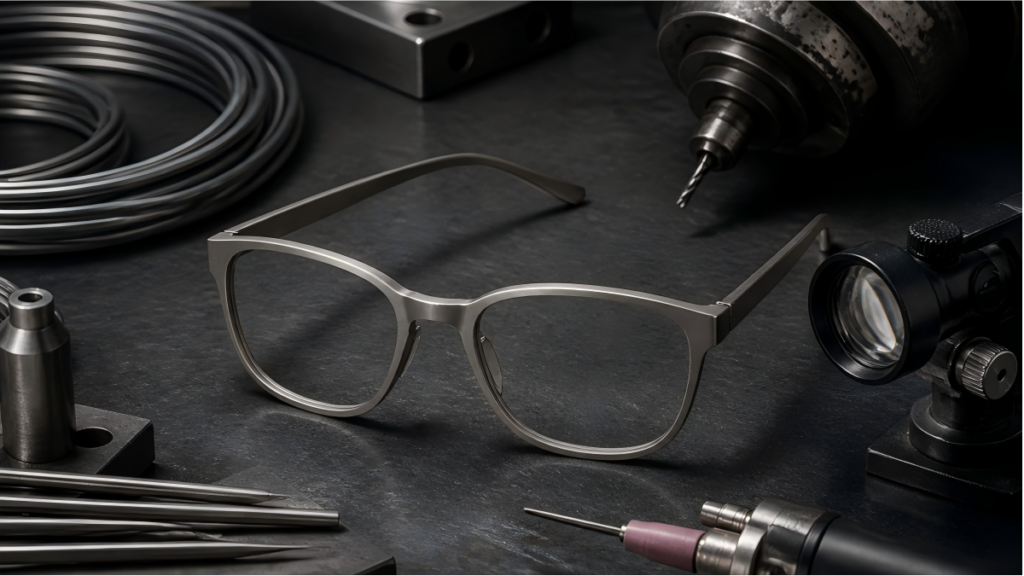
Titânio frames are the hardest eyewear to manufacture because they combine four unforgiving challenges: expensive raw material with a 40%+ scrap rate, welding that requires skills most factories simply do not have, a material that work-hardens as you cut it, and quality tolerances measured in 0.05mm.
Most factories quote titanium frames but secretly outsource them. A factory that actually welds titanium in-house — rather than riveting or gluing it — is a factory with a genuinely advanced capability. This article explains, from inside a production floor, why titanium separates serious manufacturers from the rest — and what it means for your brand if you are considering a titanium collection.
Challenge 1: Raw Material Cost + Scrap Rate
Titanium sheet and wire cost 8-15x more per kilogram than stainless steel. But the real cost driver is the scrap rate.
| Material | Relative Raw Cost | Typical Scrap Rate | Effective Cost Impact |
|---|---|---|---|
| Stainless steel | 1.0x | 10-15% | 1.0x baseline |
| Aluminum alloy | 1.2x | 12-18% | 1.2x |
| Titanium (pure) | 8-12x | 30-45% | 11-17x |
| Titanium (beta) | 12-18x | 35-50% | 16-26x |
Why so much scrap? Titanium has “springback” — when you bend or press it, it returns partway to its original shape. A press operator sets a 30-degree bend and the frame springs back to 25 degrees. Correcting this requires re-pressing, and every re-press risks fatigue cracks. First-pass yield on complex titanium temples is often below 60%.
Unlike acetate (where scrap is just material), titanium scrap from CNC cutting is mostly chips and dust — difficult to recycle cost-effectively at small scale.
Challenge 2: Welding Is the Gatekeeper Skill
This is the single biggest reason titanium frames are “hard.”
Stainless steel and aluminum can be riveted, screwed, or spot-welded with standard equipment. Assembly errors are fixable — grind the weld, re-weld, polish.
Titanium cannot be riveted well (the joint fatigues), cannot be glued reliably (titanium’s oxide layer resists adhesives), and cannot be welded with ordinary methods (oxygen contamination ruins the weld).
Titanium welding demands:
- A pure argon atmosphere around the weld — even a 0.5% oxygen leak turns the weld brittle and discolored
- A skilled welder — typically 5,000+ hours of titanium-specific experience. A welder who only knows steel cannot weld titanium without extensive retraining
- Strict pre-cleaning — any oil, grease, or fingerprint on the joint area contaminates the weld
- Controlled heat input — titanium dissipates heat slowly; excess heat creates large, weak weld zones
The practical consequence: a factory that says “we make titanium frames” without being able to show you their argon welding stations is almost certainly outsourcing the welding or avoiding it.
Challenge 3: Work-Hardening During Machining
Titanium has a property that makes it frustrating to machine: it work-hardens. As you cut it, the surface layer hardens — which then destroys your cutting tool faster.
| Effect | Consequence |
|---|---|
| Tool wear accelerates | Cutting tools last 50-70% shorter on titanium than steel |
| Heat builds at cutting edge | Requires slow speeds + constant coolant, slowing production |
| Hardened layer cracks | Can create micro-cracks that fail during wear |
| Chatter at high speeds | Poor surface finish, dimensional drift |
Production reality: a titanium temple that takes 3 minutes to CNC-cut in steel takes 8-12 minutes in titanium, with tooling costs 2-3x higher.
Challenge 4: Tolerance in 0.05mm
Titanium frames are measured differently. On an acetate frame, a 0.3mm variation is invisible. On a titanium frame, hinge placement must be within 0.05mm or the temple won’t close flush — and customers will feel it immediately.
Critical tolerance points:
| Checkpoint | Tolerance | Failure If Exceeded |
|---|---|---|
| Hinge screw hole position | ±0.05mm | Temple misalignment, stripped threads |
| Temple bend radius | ±0.3mm | Pressure points behind ears |
| Frame front symmetry | ±0.2mm | Visible warp when worn |
| Weld joint thickness | ±0.1mm | Cosmetic ridge or weak point |
Meeting these tolerances requires CMM (coordinate measuring machine) inspection — not just calipers — on every production batch. This is equipment many “titanium frame factories” do not own.
Why Factories Still Make Titanium Frames
| Reason | Explanation |
|---|---|
| Premium positioning | Titanium frames command 2-4x retail price points |
| Hypoallergenic | Pure titanium is biocompatible — ideal for sensitive skin |
| Weight | 40-60% lighter than steel equivalents |
| Durability | Corrosion-resistant, holds adjustment well |
| Brand story | “Titanium” is a word customers understand and value |
The brands that sell titanium successfully are selling the material story — and the manufacturing difficulty is exactly why the story works. If titanium frames were easy to make, they would not be premium.
What This Means for Your Brand
If you are sourcing titanium frames:
- Ask the factory to show you their welding stations — argon tanks, welding benches, and trained welders. A factory that pivots to “we outsource welding” is a different proposition
- Request a weld cross-section sample — a properly welded titanium joint shows a clean, continuous weld bead; a brittle weld shows porosity
- Expect higher sampling costs — titanium pre-production samples cost more because the material and rejects cost more
- Plan longer lead times — titanium orders run 7-10 days longer than equivalent acetate orders (see our full OEM timeline for reference)
The honest factory test:
Ask any factory: “Do you weld titanium in-house?” The answer tells you more about their capability than any brochure. If they hesitate, they don’t.
Frequently Asked Questions
Is titanium really hypoallergenic?
Pure titanium and beta-titanium are biocompatible and hypoallergenic. Nickel-containing alloys are not. Check the actual alloy composition — some “titanium” frames are titanium-coated stainless steel.
Why do some titanium frames cost less?
Price is the first signal. A genuinely welded titanium frame cannot be produced below a certain cost floor. Frames far below that floor are either titanium-coated steel, riveted titanium, or thin titanium with inferior welds.
Can titanium frames be adjusted?
Yes — this is a key advantage. Unlike acetate (which needs heat) or plastic (which cracks), titanium can be adjusted cold by a trained optician. It holds the adjustment well.
Is titanium or beta-titanium better?
They serve different purposes. Pure titanium is more rigid and slightly heavier; beta-titanium is more flexible and lighter. The right choice depends on frame style — see our separate comparison guide.
How long do titanium frames last?
With proper care, 5-10+ years. Titanium does not corrode like steel, does not fade like acetate, and does not become brittle like plastic. The weak points are the hinges and welds — which is why weld quality matters so much.