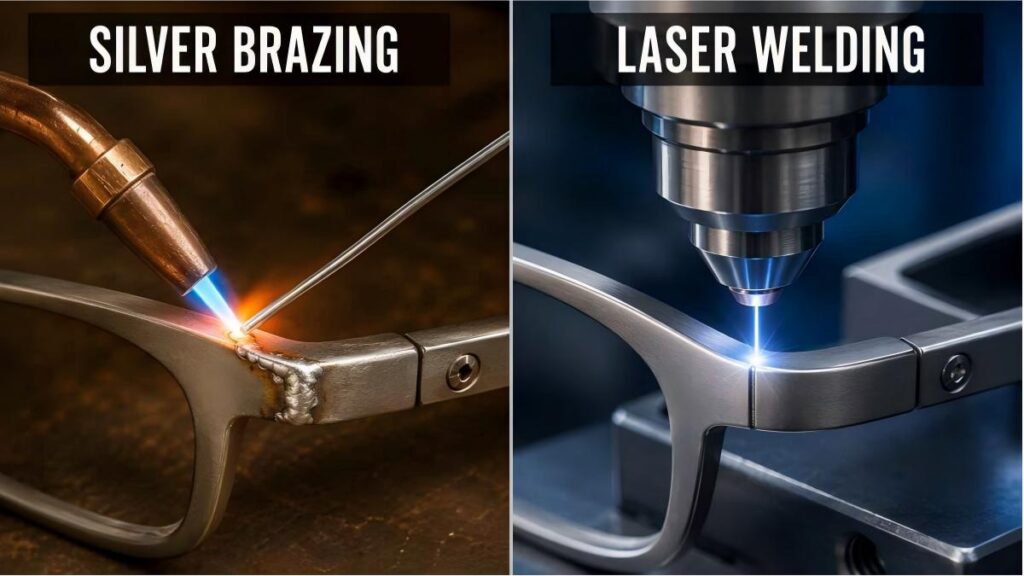
Silver brazing and laser welding are the two joining methods used to assemble titanium eyewear frames, and they produce fundamentally different results. Silver brazing joins titanium parts with a silver-based filler metal at lower temperatures — it is the traditional method, stronger in fatigue but visually visible at the joint. Laser welding fuses the titanium itself without filler metal — it is cleaner looking but demands more precision.
For most premium titanium collections, the choice is not “which is better” but “which fits your frame design and brand positioning.” This guide explains how each method works, where each excels, and what to specify when you brief a factory.
The Two Methods at a Glance
| Silver Brazing | Laser Welding | |
|---|---|---|
| Process | Filler metal (silver alloy) melted between parts at ~700-800°C | Titanium itself melted and fused by focused laser beam |
| Filler material | Silver-based solder | None — parent metal fuses |
| Joint appearance | Slightly visible seam, can be polished smooth | Nearly invisible seam |
| Joint strength | Excellent fatigue resistance | Strong, but weld quality is skill-dependent |
| Heat affected zone | Smaller, controlled | Potentially larger, needs careful parameter control |
| Equipment cost | Lower | Higher (laser welder + argon environment) |
| Skill level required | High | Very high |
| Best for | Complex assemblies, frames needing flexibility | Thin, elegant frames where seam must be invisible |
Silver Brazing: The Traditional Workhorse
Silver brazing has been used in eyewear manufacturing for decades — including by many European luxury frame manufacturers.
How it works:
- The two titanium parts are positioned with the joint gap exposed
- Silver-based brazing alloy (often containing a small amount of titanium or copper) is placed at the joint
- The assembly is heated in a controlled environment (often with flux or in a protective atmosphere) to 700-800°C
- The filler melts, flows into the joint gap by capillary action, and solidifies to form the bond
Advantages:
- Proven reliability — decades of industry data on joint performance
- Good fatigue strength — the filler metal absorbs some stress, reducing crack propagation
- Forgiving of small gaps — capillary action fills gaps up to ~0.1mm
- Lower equipment investment — a factory with silver brazing capability is more common
Disadvantages:
- Visible seam — the brazed joint is slightly visible unless carefully polished; on ultra-thin frames this can be a challenge
- Filler metal matters — low-quality silver solder with high zinc content can corrode or weaken over time
- Slower process — each joint takes careful setup, making it slower than laser for high-volume runs
Laser Welding: The Precision Modern Method
Laser welding has become the method of choice for premium, ultra-thin, and seamless titanium frames.
How it works:
- The two titanium parts are precisely clamped
- A focused laser beam (typically pulsed Nd:YAG or fiber laser) melts the titanium at the joint
- The molten titanium fuses the two parts together — no filler metal
- Welding happens under an argon shield to prevent oxygen contamination
Advantages:
- Nearly invisible seams — the fused joint can be polished to be indistinguishable from the surrounding metal
- Precision — laser spot size can be controlled to 0.2-0.5mm, ideal for delicate temple joints
- Speed — a skilled laser operator can complete a joint in seconds, faster than brazing setup
- No filler metal concerns — no corrosion risk from solder composition
Disadvantages:
- Skill-dependent — a poor laser weld is worse than a good braze: porosity, cracks, or incomplete fusion are invisible until failure
- Heat management — titanium’s low thermal conductivity means heat can build up, causing large heat-affected zones if parameters are wrong
- Higher equipment investment — quality laser welders with argon control are expensive
- Zero tolerance for contamination — any oil or residue on the joint ruins the weld
Which Method Fits Which Frame Design?
Choose silver brazing if:
- Your frame has complex multi-part assemblies — e.g., acetate fronts with titanium temples, where different materials meet
- Your design uses thicker titanium profiles where a slightly visible seam is acceptable
- You are working with a factory whose brazing experience is well documented
- You prioritize proven fatigue performance over invisible seams
Choose laser welding if:
- Your frame is ultra-thin or minimalist where any seam ruins the aesthetic
- You want a seamless, premium look — the joint disappears after polishing
- Your factory has demonstrated laser welding capability with argon shielding
- You are producing repetitive, identical joints at volume where laser speed pays off
The Question to Ask Your Factory
Instead of asking “which method is better,” ask:
“Show me your welding area. Do you silver-braze or laser-weld titanium? Can I see a cross-section of a finished weld?”
The best answer is a factory that can do both — silver brazing for complex assemblies, laser welding for visible joints — and can show you sample cross-sections of each.
A factory that offers only one method is not wrong; they are just specialized. The question is whether their specialty matches your design.
Frequently Asked Questions
Is laser welding always stronger than brazing?
No. A well-executed braze joint has excellent fatigue performance. A poor laser weld (porosity, incomplete fusion) is weaker. Method matters less than execution quality.
Can you see the difference on the finished frame?
On polished, ultra-thin frames, yes — laser-welded seams are nearly invisible while brazed seams may be faintly visible. On thicker frames, the difference disappears after polishing.
Why does titanium need argon during welding?
At welding temperature, titanium reacts aggressively with oxygen and nitrogen in the air. Even tiny amounts create brittle, discolored welds that can crack. Argon shields the weld from air.
Does brazing affect the titanium’s hypoallergenic properties?
Brazing uses silver-based filler at the joint. Silver is generally hypoallergenic, but the joint area is a different material than pure titanium. For fully hypoallergenic claims, laser welding (no filler) is technically cleaner — though in practice most wearers never contact the brazed joint area.
Discuss the best joining method for your frame design →