
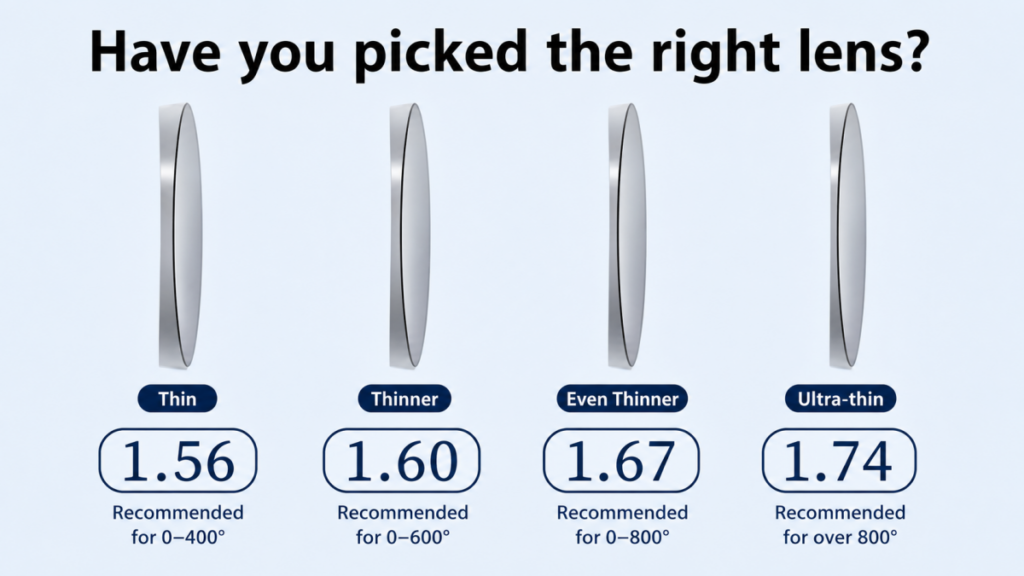
When selecting prescription lenses, many people assume that the higher the refractive index, the better the lens. While high-index lenses are thinner and lighter, choosing the highest refractive index is not always the best solution.
For optical retailers, eyewear brands, and consumers alike, the ideal lens depends on several factors, including prescription strength, frame size, optical performance, and comfort.
In this guide, we’ll explain how lens refractive index works and help you choose the most suitable option for different eyewear needs.
What Is Lens Refractive Index?
The refractive index measures how efficiently a lens material bends light.
A higher refractive index means light is bent more efficiently, allowing manufacturers to produce thinner lenses for the same prescription.
Simply put:
- Higher index = Thinner lenses
- Lower index = Slightly thicker lenses but often better optical clarity
Understanding this balance is essential when selecting the right lenses.
Does a Higher Refractive Index Mean Better Lenses?
Not necessarily.
One common misconception is that the highest refractive index always offers the best visual experience.
In reality, higher-index lenses generally have a lower Abbe Value, which measures how much chromatic aberration (color fringing) a lens produces.
Lower Abbe values may result in:
- Slight color distortion
- Reduced edge clarity
- Increased peripheral aberration
For many prescriptions, choosing a moderate refractive index provides a better balance between thinness, visual quality, and cost.
Recommended Refractive Index by Prescription
1.56 Index – Standard Thin Lenses
Recommended Prescription:
0.00 to -4.00D
Advantages:
- Affordable
- Excellent optical clarity
- High Abbe value
- Suitable for most everyday prescriptions
Ideal for:
- Reading glasses
- Everyday prescription eyewear
- Standard plastic frames
1.60 Index – The Most Balanced Choice
Recommended Prescription:
-4.00D to -6.00D
Advantages:
- Noticeably thinner than 1.56
- Comfortable weight
- Good optical performance
- Cost-effective
For many optical retailers, 1.60 lenses are considered the best all-around solution.
1.67 Index – Ideal for Stronger Prescriptions
Recommended Prescription:
-6.00D to -8.00D
Advantages:
- Slim appearance
- Reduced edge thickness
- Lighter weight
- Suitable for fashionable thin frames
This refractive index is popular among customers who want both comfort and aesthetics.
1.74 Index – Ultra-Thin Premium Lenses
Recommended Prescription:
Above -8.00D
Advantages:
- Thinnest available plastic lenses
- Maximum weight reduction
- Premium appearance
Because of the higher cost and lower Abbe value, 1.74 lenses are generally recommended only for very strong prescriptions where thickness reduction is essential.
Other Important Factors Besides Refractive Index
Selecting the right lens is not only about prescription power.
Several additional factors significantly influence comfort and appearance.
1. Frame Size Matters
Large eyewear frames require larger lens blanks.
As frame size increases, lens edge thickness also increases.
Choosing a slightly higher refractive index for oversized frames helps maintain a cleaner, thinner profile.
Smaller frames, however, often look perfectly fine with standard-index lenses.
2. Aspheric vs. Spherical Lenses
Modern aspheric lenses offer several advantages over traditional spherical designs.
Benefits include:
- Flatter lens profile
- Reduced peripheral distortion
- Wider clear viewing area
- Better cosmetic appearance
- More natural eye appearance behind the lens
For customers seeking premium visual performance, aspheric lenses are often the preferred option.
3. Accurate Eye Examination Is Essential
Even the highest-quality lens cannot deliver comfortable vision without an accurate prescription.
Professional eye examinations ensure:
- Correct prescription power
- Proper pupillary distance (PD)
- Accurate fitting height
- Better long-term wearing comfort
4. Professional Lens Processing
Lens edging and mounting also affect the final eyewear quality.
Proper processing ensures:
- Accurate alignment
- Balanced appearance
- Secure lens fitting
- Comfortable daily wear
For optical retailers, choosing an experienced manufacturing partner is just as important as selecting the right lens material.
Which Refractive Index Is Best?
There is no single “best” refractive index.
Instead, the best choice depends on:
- Prescription strength
- Frame design
- Lens size
- Budget
- Cosmetic expectations
- Visual performance requirements
Finding the right balance between lens thickness, optical quality, and cost is the key to customer satisfaction.
How MELLUME Supports Global Eyewear Brands
At MELLUME, we have been manufacturing premium eyewear since 2006, serving global distributors, optical retailers, and private-label brands.
Our expertise includes:
- Optical frames
- Sunglasses
- Acetate eyewear
- Titanium frames
- Wooden eyewear
- Horn eyewear
- OEM & ODM manufacturing
- Sustainable eyewear solutions
By combining professional frame manufacturing with practical optical knowledge, we help our partners recommend the most suitable eyewear solutions to their customers.
Frequently Asked Questions
Is a 1.74 lens always better than a 1.60 lens?
No. While 1.74 lenses are thinner, they are primarily recommended for very strong prescriptions. For moderate prescriptions, 1.60 lenses often provide better value and excellent visual quality.
Which refractive index is best for -5.00D?
For prescriptions around -5.00D, 1.60 index lenses are generally considered the best balance between thickness, comfort, and optical performance.
Why do high-index lenses sometimes have lower optical clarity?
Higher-index materials usually have lower Abbe values, which may produce slightly more chromatic aberration than standard-index lenses.
Do larger frames require higher-index lenses?
In many cases, yes. Larger frames increase lens edge thickness, and higher-index materials help create a slimmer, lighter appearance.
Should I choose lens thickness based only on my prescription?
No. Frame size, lens design, optical quality, and professional fitting all play important roles in selecting the ideal lenses.
Final Thoughts
Choosing the proper lens refractive index is about finding the right balance—not simply selecting the highest number available.
For optical retailers and eyewear brands, understanding how refractive index, frame size, lens design, and optical performance work together allows you to provide better recommendations, improve customer satisfaction, and reduce unnecessary costs.
At MELLUME, we are committed to helping our global partners deliver high-quality eyewear solutions through professional manufacturing, sustainable materials, and years of OEM/ODM expertise.