You reduce quality risk when sourcing sunglasses from China with six controls: sample approval before production, a written spec agreement, in-production QC checkpoints, third-party pre-shipment inspection, a clear defect and return policy, and supply chain documentation.
Each control closes a specific failure window — together they cut your defect rate from “whatever the factory ships” to a defined, measurable level. This guide explains each control in order of importance, and what a factory should provide at every stage.
Control 1: Approve a Physical Sample Before Production (Non-Negotiable)
The sample is your only way to verify that the factory understands your spec. Never approve production based on photos.
What to check on the sample:
| Check | How |
|---|---|
| Color accuracy | Compare against your Pantone reference or physical swatch |
| Lens quality | Tint, coating, UV transmission if you have a tester |
| Logo placement | Position, size, clarity — compare against your artwork |
| Finish | Run fingers along edges — bridge, temple tips, hinge areas |
| Fit | Wear-test the frame: slippage, temple pressure, symmetry |
| Hardware | Open/close hinges 20 times; check for looseness or clicking |
The sample sign-off document should record: approved date, sample photo, and any deviations accepted. This document becomes your quality baseline for production.
Control 2: Put the Spec in Writing (Both Sides Sign It)
Verbal agreements are how quality disputes start. Before production, both sides sign a spec document covering:
- Materials (acetate supplier, sheet thickness)
- Dimensions (frame width, lens size, temple length — with tolerances)
- Lens specification (type, coating, UV performance)
- Logo technique and placement
- Packaging specification
- Accepted defect rate (industry standard: AQL 2.5 for general inspection)
- Key deadlines (sample, production, shipment)
Why this matters: When a dispute arises, the written spec — not the salesperson’s promise — is the reference point. A factory that refuses to sign a spec document is telling you something.
Control 3: In-Production QC Checkpoints
Don’t wait until shipment to discover a problem. Define QC checkpoints during production:
| Checkpoint | What to Verify |
|---|---|
| Material arrival | Correct acetate sheet, lens type, hardware matches spec |
| After CNC cutting | Frame shape, dimensions within tolerance |
| After polishing | Finish quality, edge smoothness |
| After assembly | Hinge function, temple alignment |
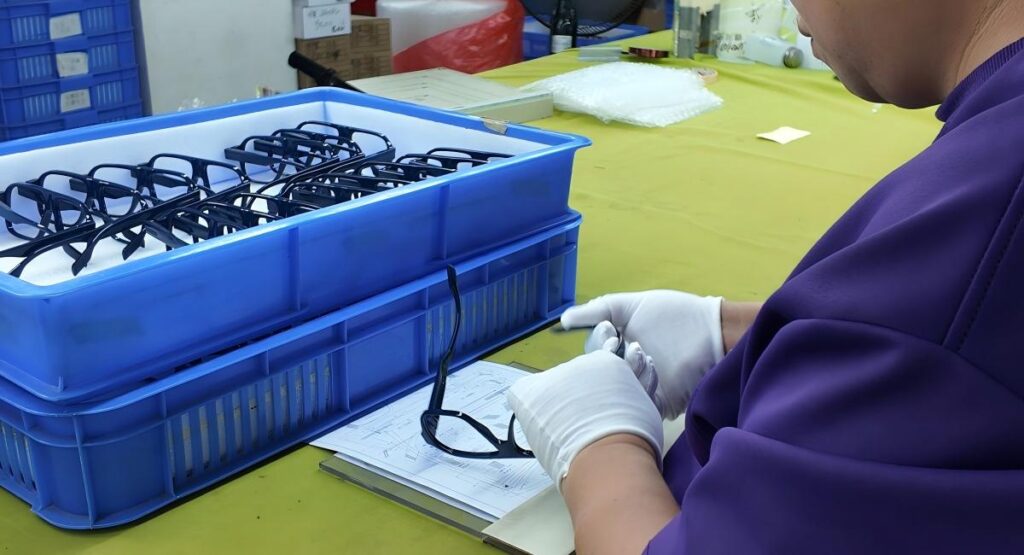
| Before packing | 100% final inspection, sample pulled for your review |
For orders above 200 pieces, schedule a mid-production video check — the factory shows you 5-10 random frames on the line. For large orders, a mid-production on-site inspection is worth the cost.
Control 4: Third-Party Pre-Shipment Inspection
A pre-shipment inspection (PSI) by an independent agency is the strongest quality control available — and the standard practice for serious buyers.
What a PSI covers:
- Quantity verification against the order
- Random sampling per AQL standards
- Dimensional checks with calibrated tools
- Surface finish inspection
- Lens and hardware function checks
- Packaging and labeling verification
Cost and logistics:
- $200-500 per inspection depending on agency and order size
- Agencies: SGS, TUV, Bureau Veritas, Intertek — all operate in Shenzhen and Wenzhou
- Lead time: schedule 5-7 days before your planned shipment date
- You receive a formal report with photos and pass/fail per criterion
The factory perspective: A factory confident in its QC welcomes PSI. Resistance to third-party inspection is itself a red flag.
Control 5: Agree on Defects and Returns Before Payment
Define what happens when defects are found — before you pay the balance.
What to agree in writing:
- What counts as a defect (vs acceptable variation): color shade tolerance, surface scratch limits, hinge tension range
- The accepted defect rate (AQL 2.5 = up to 2.5% of random-sample defects accepted)
- What happens above the threshold: rework at factory cost, discount, or replacement
- Return policy: who pays return shipping for defective goods
- What is excluded: normal wear, misuse, damage in transit after handover
Common approach: The factory reworks or replaces defective frames at their cost, or issues a credit against the next order. Rework within the factory is far cheaper for both sides than shipping defective goods back.
Control 6: Keep Supply Chain Documentation
Documentation protects you beyond the current order:
| Document | Purpose |
|---|---|
| Signed spec document | Quality baseline and dispute reference |
| Sample photos + sign-off | Proof of approved baseline |
| Test reports (FDA, CE, REACH) | Market entry compliance proof |
| Certificate of origin | Customs and buyer requirements |
| BSCI audit report | Social compliance evidence |
| Inspection report (if PSI used) | Third-party quality proof |
| Payment and shipping records | Audit trail for the relationship |
Keep copies of everything in one folder per order. When a market authority, retailer, or future customer asks for compliance evidence, you have it in minutes instead of weeks.
How the Six Controls Map to Failure Windows
| Failure Window | Control That Closes It |
|---|---|
| Factory misunderstands your spec | Control 1 (sample) + Control 2 (written spec) |
| Errors during production | Control 3 (in-production checkpoints) |
| Defects shipped unnoticed | Control 4 (third-party inspection) |
| Defects found after arrival | Control 5 (defect/return policy) |
| Compliance questions later | Control 6 (documentation) |
Frequently Asked Questions
What is AQL and what level should I use?
AQL (Acceptable Quality Limit) is the industry sampling standard. For general eyewear inspection, AQL 2.5 (major defects) is standard. Premium brands often use AQL 1.0 — ask your inspection agency to confirm what your order needs.
Can I skip the sample for a small order?
Technically yes, but don’t. A 50-piece order with a wrong logo costs more in time and reputation than the sample fee.
What if the factory’s QC report conflicts with my inspection report?
The third-party report wins. That is the point of using an independent agency — both sides agreed to it as the referee.
How do I handle quality issues that only appear after months of use?
This is why the warranty clause matters. Agree in writing that structural defects (hinge breakage, frame cracking, lens delamination) discovered within a defined warranty period are covered — typically 6-12 months from receipt.
Are all Chinese factories low quality?
No. China produces the majority of the world’s premium eyewear — including frames for European luxury brands. Quality varies by factory, not by country. The six controls are how you find the quality factories.
Get a factory tour and audit documents — we welcome verification →