A logo is one of the smallest details on an eyewear frame, but it can have a strong influence on how a finished product looks and feels.
For custom eyewear brands, logo application is not simply about putting a brand name on the temple. The position, material, production method, color, depth, and finishing all affect the final result.
Different logo techniques also work better with different frame materials and design structures.
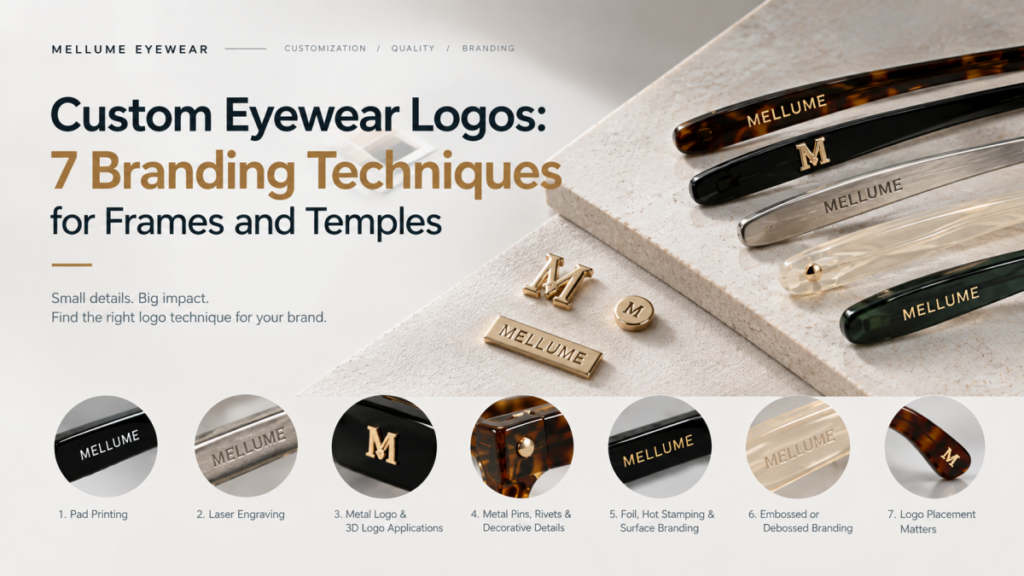
Here are seven commonly used branding techniques to consider when developing custom eyewear.
1. Pad Printing
Pad printing is one of the most widely used methods for adding logos and small graphics to eyewear.
It is suitable for relatively fine lettering and can be applied to areas such as temples, inner temples, and other relatively flat surfaces.
Different ink colors can be used to match the brand identity or contrast with the frame.
One advantage is its flexibility for relatively small logo applications. However, the final result depends on the surface condition, logo size, ink selection, and application process.
For small logos, the artwork should therefore be prepared with the actual printing area in mind rather than simply reducing a large logo.
2. Laser Engraving
Laser engraving creates the logo directly on the surface of the frame or component.
It can be used for fine lines, text, symbols, serial information, and other small details.
On metal and titanium frames, laser marking can create a clean and relatively understated appearance. It can also work well when a brand wants the logo to feel integrated into the material rather than appearing as a separate graphic.
The result depends on the material, surface treatment, laser settings, and desired depth or contrast.
For custom projects, the manufacturer should confirm the appropriate laser parameters before mass production because different materials and finishes can produce different visual results.
3. Metal Logo and 3D Logo Applications
Metal logos can create a more dimensional appearance and are often used when a brand wants the logo to become a visible design element.
A metal logo can be made in different shapes, thicknesses, finishes, and colors. It may be attached to the temple, front frame, or another suitable area depending on the design.
A 3D metal logo can also create a stronger tactile effect than a printed logo.
However, dimensional logos need to be considered together with the frame structure. The attachment method, logo thickness, surrounding space, and weight all need to be appropriate for the frame.
For example, a highly detailed metal logo may look attractive as a standalone component but require simplification when the available temple area is very small.
4. Metal Pins, Rivets, and Decorative Logo Details
A logo does not always need to be a complete printed or raised graphic.
Small metal pins, rivets, or decorative elements can also be used as part of a brand identity.
This approach is particularly interesting for acetate frames because a small metal detail can be integrated into the front or temple without making the branding visually dominant.
The shape, diameter, placement, and finishing of the metal component all contribute to the final appearance.
The key is to make the decorative detail work with the frame design rather than simply adding another element to it.
5. Foil, Hot Stamping, and Surface Branding
Foil or hot stamping can create a metallic or high-contrast logo effect on suitable surfaces.
This type of branding is often considered when a brand wants a more decorative appearance without adding a separate three-dimensional component.
The result can vary depending on the surface material, temperature, pressure, foil type, and application area.
For eyewear, the available space is often limited, so logo size and placement need to be tested carefully.
A logo that looks balanced on a large packaging surface may appear too heavy when transferred directly to a narrow temple.
6. Embossed or Debossed Branding
Embossing creates a raised logo, while debossing creates a recessed effect.
These techniques can give the frame a more integrated appearance because the branding becomes part of the surface rather than sitting on top of it.
For acetate, this type of treatment can be considered when the material thickness and frame structure provide enough space for the desired effect.
However, not every logo design is suitable for embossing or debossing. Very fine details may not reproduce clearly, and the available depth needs to be considered during design development.
The logo should therefore be evaluated together with the material thickness and production method.
7. Logo Placement Matters as Much as the Technique
Choosing the branding technique is only part of the process.
Where the logo is placed can have an equally important effect on the final product.
Common areas include:
- Outer temple
- Inner temple
- Front frame
- Temple tip
- Bridge area
- Metal components
The outer temple usually provides stronger visual exposure, while an inner-temple logo can create a more understated brand detail.
The available surface area also affects which technique is practical.
A detailed 3D metal logo may need more space than a simple laser mark, while a small printed logo may work well on a narrow temple.
This is why logo design should be developed together with the frame rather than added after the frame structure has already been finalized.
How Should a Brand Choose the Right Logo Technique?
There is no single branding method that works for every custom eyewear project.
A useful starting point is to consider four factors:
Frame material
Acetate, titanium, and other materials may require different application methods.
Available space
A narrow temple limits the size and complexity of the logo.
Visual effect
Decide whether the logo should be subtle, decorative, metallic, dimensional, or highly visible.
Production consistency
The selected technique needs to remain consistent across the production quantity, not just look good on one prototype.
These decisions should be discussed before the final prototype and mold are completed.
Our previous article, Can Your Eyewear Design Be Mass Produced? 7 Things to Check Before Mold Development, explains why details such as structure, components, finishing, and production consistency should be considered before moving into mass production.
Need Help Developing Your Eyewear Branding?
If you already have a logo and a frame concept, you can share the artwork with the manufacturer before finalizing the frame.
The manufacturer can review the available space, material, logo dimensions, and suitable application method before the design moves further into production.
Discuss Your Custom Eyewear Project
Final Checklist
- Is the logo suitable for the selected frame material?
- Is there enough space for the chosen technique?
- Does the logo size work with the frame proportions?
- Is the desired finish clear?
- Will the logo remain readable after production?
- Is the attachment or application method suitable for the frame structure?
- Can the same appearance be reproduced consistently?
Final Thoughts
A well-designed eyewear logo should feel like part of the frame rather than an afterthought.
Pad printing and laser engraving can work well for clean and relatively subtle branding, while metal logos, pins, and dimensional details can create a stronger physical presence.
The right choice depends on the material, frame structure, available space, visual direction, and production requirements.
For Full Custom OEM/ODM eyewear projects, discussing logo placement and application methods early can help ensure that the branding works with the frame design from the beginning.
Developing a new eyewear collection?
Share your logo, frame sketches, or reference images with our OEM/ODM team to discuss practical branding options.
Start Your Custom Eyewear Project
FAQ
1. What is the best way to add a logo to custom eyewear?
It depends on the material, logo size, desired appearance, and available space. Pad printing, laser engraving, metal logos, and other techniques each have different applications.
2. Can I use a 3D metal logo on an acetate frame?
Yes. Metal logos can be integrated with acetate frames, but the attachment method, logo thickness, available space, and surrounding frame structure need to be considered.
3. Is laser engraving suitable for titanium eyewear?
Laser marking can be used on titanium and other metal frames, but the settings and expected appearance should be tested on the specific material and surface finish.
4. Should the logo be designed before the eyewear frame?
Ideally, the logo placement and approximate dimensions should be considered during frame development so that the branding fits naturally within the available structure.
5. Can the same logo use different techniques across a collection?
Yes. A brand may use different techniques depending on the frame material, design, and product positioning, as long as the overall brand identity remains consistent.