When a custom eyewear project moves from prototype approval to mass production, one of the biggest challenges is not simply making the frame. It is making every production batch consistent with the approved sample.
A prototype may look perfect when only one or two pieces are being evaluated. But once production involves hundreds or thousands of frames, small differences in dimensions, color, finishing, assembly, or components can become much more noticeable.
For eyewear brands, consistency affects both product quality and customer experience. A reliable manufacturing process therefore needs clear standards from the approved prototype through final inspection.
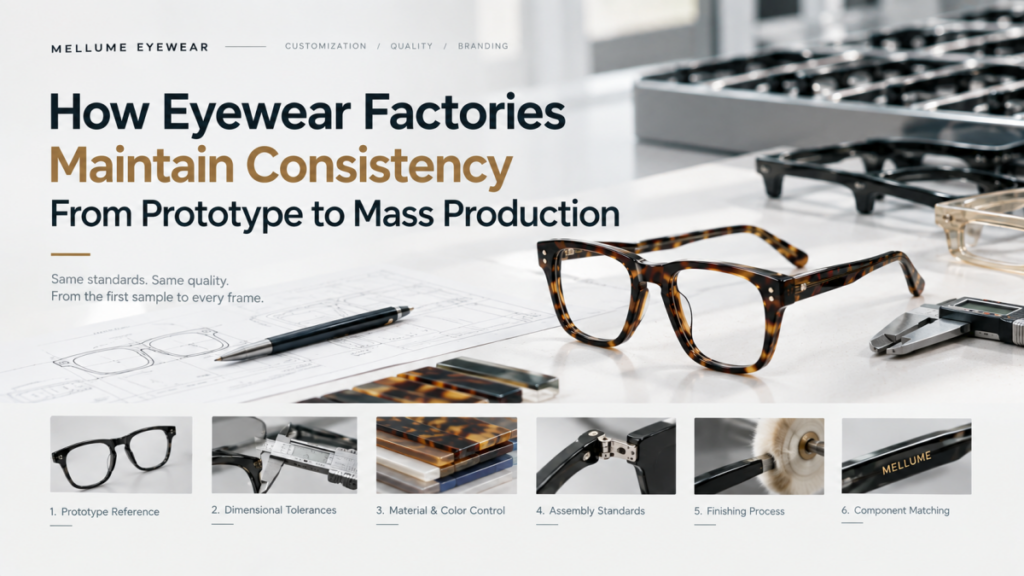
Here are the key areas eyewear factories need to control.
1. The Approved Prototype Becomes the Production Reference
Before mass production starts, the factory needs a clearly approved sample to use as the reference.
This sample should represent the final requirements for:
- Frame shape and dimensions
- Acetate color and pattern
- Metal finish
- Lens shape and fitting
- Hinge position
- Nose pad configuration
- Temple length and angle
- Logo placement
- Surface finishing
The prototype is more than a visual reference. It should become a practical production standard.
This is why brands should carefully evaluate a prototype before giving production approval. If changes are still needed, it is usually better to solve them at the prototype stage rather than after mass production begins.
For more information, see our guide on Eyewear Design for Manufacturing.
2. Dimensional Tolerances Need to Be Defined
No manufacturing process can guarantee that every frame will be mathematically identical.
Instead, factories work within controlled tolerances.
For eyewear, important dimensions can include:
- Lens width
- Bridge width
- Temple length
- Frame front width
- Lens height
- End-piece position
- Hinge location
- Temple angle
For example, if a temple needs to maintain a specific angle relative to the front frame, the production team needs a defined acceptable range rather than relying only on visual judgment.
The same applies to drilling, hinge positioning, lens fitting, and other structural details.
Good production control means identifying which dimensions are critical and monitoring them during production.
3. Material and Color Must Be Controlled by Batch
Material consistency is especially important for acetate eyewear.
Two acetate sheets may use the same color name but still show slight differences between material batches. Patterns, transparency, color depth, and surface appearance can vary depending on the material itself.
For this reason, factories need to control material sourcing and batch selection carefully.
For a custom collection, the approved prototype should be compared with the production material before large-scale processing begins.
This is particularly important for:
- Transparent acetate
- Marble patterns
- Tortoiseshell patterns
- Gradient colors
- Multi-layer acetate
- Custom color matching
For metal frames, surface appearance also needs control. Plating, polishing, brushing, and other finishing processes need consistent process parameters to reduce visible differences between batches.
4. Assembly Must Follow the Same Standard
A frame can have accurate components but still look different if assembly is inconsistent.
During production, workers need to maintain consistent standards for:
- Hinge installation
- Temple alignment
- Nose pad positioning
- Screw tightening
- Front-to-temple alignment
- Lens installation
- Component fitting
For example, a slightly different temple angle on each frame may not seem significant when looking at one piece. Across a large shipment, however, inconsistent alignment becomes much easier to notice.
This is why experienced eyewear production relies on both skilled assembly and inspection procedures.
5. Surface Finishing Requires Process Control
Finishing is another area where prototype-to-production consistency can become difficult.
Acetate frames may require several steps such as cutting, edge shaping, tumbling, hand polishing, and final buffing.
Metal frames may involve polishing, plating, laser processing, welding, or other surface treatments.
The approved prototype shows the desired result, but production teams also need to control the process that creates that result.
At Mellume, different frame materials require different manufacturing and finishing approaches. Our eyewear craftsmanship and manufacturing processes cover areas such as acetate polishing, metal processing, hinge work, and final quality inspection.
6. Components Need to Match the Approved Sample
Consistency does not only apply to the frame itself.
Small components can also change the finished product.
Examples include:
- Hinges
- Screws
- Nose pads
- Metal pins
- Decorative parts
- Logo components
- Lens specifications
If a component changes during production without proper approval, the finished frame may feel or look different even when the main frame dimensions remain unchanged.
For custom eyewear, component specifications should therefore be confirmed before mass production.
7. Pilot Production Helps Identify Problems Early
Before producing the full order, a factory can use an initial production run to check whether the approved prototype can be reproduced consistently.
This stage is useful for identifying issues such as:
- Unexpected material behavior
- Color differences
- Assembly variation
- Hinge alignment problems
- Surface finishing inconsistencies
- Difficulties during lens installation
- Production tolerances that need adjustment
If a problem appears during this stage, it can often be corrected before the entire order is completed.
This is particularly important for complex custom frames, where a small production issue can become expensive if discovered only after thousands of pieces have been produced.
The design feasibility stage discussed in Can Your Eyewear Design Be Mass Produced? helps address many potential problems before this stage begins.
8. Final QC Should Compare Against Defined Standards
Final inspection should not depend entirely on whether a frame “looks okay.”
A professional QC process should have defined inspection points.
Depending on the product, these may include:
- Frame dimensions
- Alignment
- Surface defects
- Color consistency
- Hinge function
- Screw condition
- Lens fitting
- Logo placement
- Plating or finishing quality
- Overall appearance
For larger production orders, inspection records can also help identify recurring problems and improve future production.
The goal is not simply to find defective pieces at the end. It is to prevent the same problem from appearing repeatedly during production.
What Should Brands Ask Their Eyewear Factory?
Before placing a custom production order, brands can ask several practical questions:
- What sample will be used as the production reference?
- Which frame dimensions are controlled by tolerance?
- How are acetate or metal material batches checked?
- How are color and finishing consistency controlled?
- How are hinge and temple alignment inspected?
- Is there an initial production or pilot inspection?
- What does the final QC process cover?
- How are production problems recorded and corrected?
These questions can tell you much more about a factory’s production control than simply asking whether it can manufacture custom eyewear.
Final Checklist
Before mass production, make sure your factory has clearly confirmed:
- Approved production sample
- Key frame dimensions
- Material and color specifications
- Component specifications
- Logo and branding details
- Finishing requirements
- Assembly standards
- Inspection points
- Acceptable production tolerances
The more clearly these standards are defined, the easier it is to maintain consistency from the first production piece to the last.
Final Thoughts
A good prototype is only the beginning of a custom eyewear project.
The real manufacturing challenge is reproducing that approved design consistently across mass production.
This requires more than equipment. It depends on clear specifications, controlled materials, standardized processes, skilled assembly, and systematic quality inspection.
For eyewear brands developing a new collection, discussing these points with the factory before production can reduce avoidable quality problems and make the transition from prototype to finished inventory much smoother.
If you are developing a custom eyewear collection and want to discuss production requirements, you can contact Mellume Eyewear with your design or product specifications.
FAQ
How does an eyewear factory maintain consistency during mass production?
Factories use approved samples, dimensional tolerances, material controls, standardized assembly procedures, finishing processes, and QC inspections to maintain consistency.
Why is the approved prototype important?
The approved prototype provides a physical reference for the production team and helps define the expected dimensions, materials, finishing, and component details.
Can every custom eyewear frame be exactly identical?
Manufacturing naturally involves small tolerances. The goal is to keep those variations within defined and acceptable production limits.
How can brands reduce quality variation?
Brands can reduce variation by confirming detailed specifications before production and working with a factory that has clear production and QC procedures.
Should a factory inspect production before the entire order is completed?
For custom eyewear, early production inspection can help identify material, assembly, finishing, or dimensional problems before they affect the full production run.