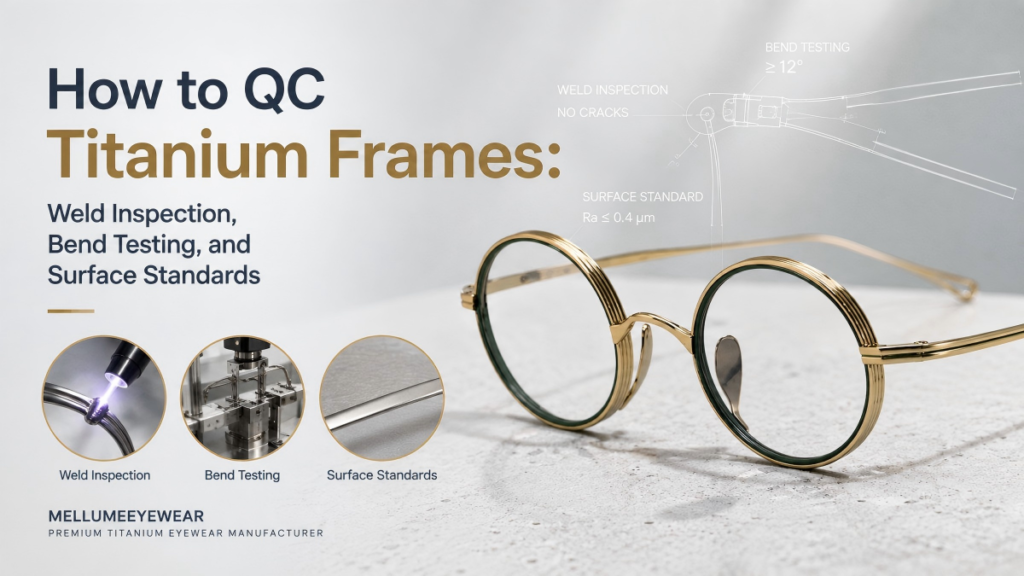
Titanium frame QC is a different discipline from acetate or steel QC. The critical checks are weld integrity, bend resistance, surface finish, and dimensional tolerance — and each requires specific tools and procedures. A titanium frame that passes visual inspection can still fail catastrophically at the weld or crack invisibly under flexing.
This guide covers what a proper titanium QC process looks like, so you can verify your factory’s process — or run your own incoming inspection.
Why Titanium QC Is Different
| Material | Primary QC Focus | Failure Mode |
|---|---|---|
| Acetate | Surface finish, color, symmetry | Scratches, color mismatch, warping |
| Steel | Cosmetic finish, hinge alignment | Corrosion, cosmetic defects |
| Titanium | Weld integrity, bend resistance | Hidden cracks, weld failure, work-hardening cracks |
The difference: acetate and steel failures are visible. Titanium failures are often internal — a cracked weld looks fine until the frame snaps. This is why titanium QC must include destructive and semi-destructive testing, not just visual inspection.
QC Check 1: Weld Integrity Inspection
Visual inspection (first pass)
Under 3-5x magnification, check every weld joint for:
| Defect | What It Looks Like | Severity |
|---|---|---|
| Porosity | Tiny pits or bubbles on weld surface | Critical — weakens joint |
| Cracking | Fine lines at weld edge or center | Critical — will propagate |
| Incomplete fusion | Gap or discontinuity at joint | Critical — joint not bonded |
| Discoloration | Blue/purple/grey tint around weld | High — oxygen contamination |
| Undercut | Groove at weld toe | High — stress concentration |
Important: Slight heat tint at the weld is not automatically a reject. A faint straw-gold tint is often acceptable (slight oxidation); blue-grey tint indicates contamination and should be rejected.
Weld cross-section test (sampling)
For each production batch, cut one sacrificial frame through the weld and inspect under 10x magnification:
- Good weld: Continuous, dense, no porosity, full penetration
- Bad weld: Porous, discontinuous, shallow penetration, inclusions
This destructive test is the only way to verify actual weld quality. A factory that refuses to do it is hiding something.
QC Check 2: Bend Testing
Titanium’s advantage is flexibility — but only if the frame can actually flex without cracking.
The manual bend test
For finished frames, trained QC staff perform a controlled bend test:
- Hold the frame front firmly
- Bend each temple outward to a defined angle (typically 20-30 degrees beyond normal)
- Release and check for:
- Cracking sound — immediate reject
- Crack lines at the hinge or weld — reject
- Permanent deformation (doesn’t return to shape) — check against spec
- Repeat 3-5 times per frame on sampling basis
The fatigue test (for sport/active collections)
For frames marketed as flexible or sport-grade, use a mechanical fatigue tester:
- Bend temple to 45 degrees, release, repeat 10,000-50,000 cycles
- Pass criteria: no cracking, no visible deformation, hinge still functions
Most standard fashion frames do not need this test. But if your brand claims “flexible titanium,” your factory should be able to produce fatigue test data.
QC Check 3: Surface Finish Standards
Titanium’s surface finish determines both aesthetics and feel.
| Finish Type | Inspection Method | Pass Criteria |
|---|---|---|
| Polished (mirror) | Reflectivity check under light | Uniform reflection, no swirl marks |
| Brushed / satin | Grain direction under raking light | Consistent grain, no cross-grain scratches |
| Matte | Tactile + visual | Even matte, no glossy patches |
| PVD coated | Adhesion + color check | No peeling, uniform color |
PVD coating adhesion test
If the frame has PVD (physical vapor deposition) coating:
- Tape test: Apply adhesive tape to coated surface, pull firmly. Coating should not peel
- Scratch test: Light scratch with a calibrated tool. Coating should not flake
- Salt spray test (for high-end): 24-48 hours in salt spray chamber. Coating should show minimal corrosion
QC Check 4: Dimensional Tolerance
Titanium frames require tighter tolerances than acetate:
| Dimension | Standard Tolerance |
|---|---|
| Hinge screw hole position | ±0.05mm |
| Frame front width | ±0.3mm |
| Temple length | ±0.5mm |
| Temple bend angle | ±0.5 degrees |
| Weld joint thickness | ±0.1mm |
Tools required:
- Digital caliper — for linear dimensions
- CMM (coordinate measuring machine) — for critical positions (hinge holes, angles)
- Feeler gauges — for gap measurements
- Angle gauge — for temple bend angles
A factory that only uses calipers cannot verify hinge hole positions to 0.05mm. Ask what measuring equipment they use.
QC Check 5: The Final Wear Test
Before packing, QC staff should wear-test a sampling of frames:
- Put the frame on for 10 seconds — check for pressure points, slippage, temple tension
- Open and close hinges 20 times — smoothness, resistance, any clicking
- Squeeze the frame gently — no cracking sound, returns to shape
- Check temple tips against skin — smooth, no sharp edges
This is the same test a customer will do at retail — it should happen at the factory first.
What to Ask Your Factory
| Question | Good Answer | Red Flag |
|---|---|---|
| “Do you do weld cross-section testing?” | “Yes, one per batch” | “We don’t cut good frames” |
| “What’s your bend test procedure?” | Specific angles and cycle counts | “We bend-check by hand” |
| “What measuring equipment do you use?” | “CMM for hinge positions” | “Calipers” |
| “Can I see a fatigue test report?” | “Here’s one from last batch” | “We don’t do that” |
| “What’s your titanium reject rate?” | Honest number (5-15% is realistic) | “Almost zero” (unlikely) |
Frequently Asked Questions
What’s a realistic titanium frame reject rate?
5-15% at final QC is normal. Zero rejects is suspicious — it usually means QC is not rigorous enough to find defects.
Can I inspect titanium frames myself without equipment?
Basic checks yes (bend test, visual weld check, hinge function). Precision checks need tools. For significant orders, third-party inspection with proper equipment is worth the cost.
How do I know if a weld is actually titanium and not glued?
Weld cross-section inspection. A glued joint shows a glue line; a welded joint shows continuous metal. Also, glued frames fail the bend test — the joint separates.
Is every titanium frame PVD coated?
No. PVD is an option, not a standard. Many premium titanium frames are uncoated — the bare titanium finish is part of the aesthetic.