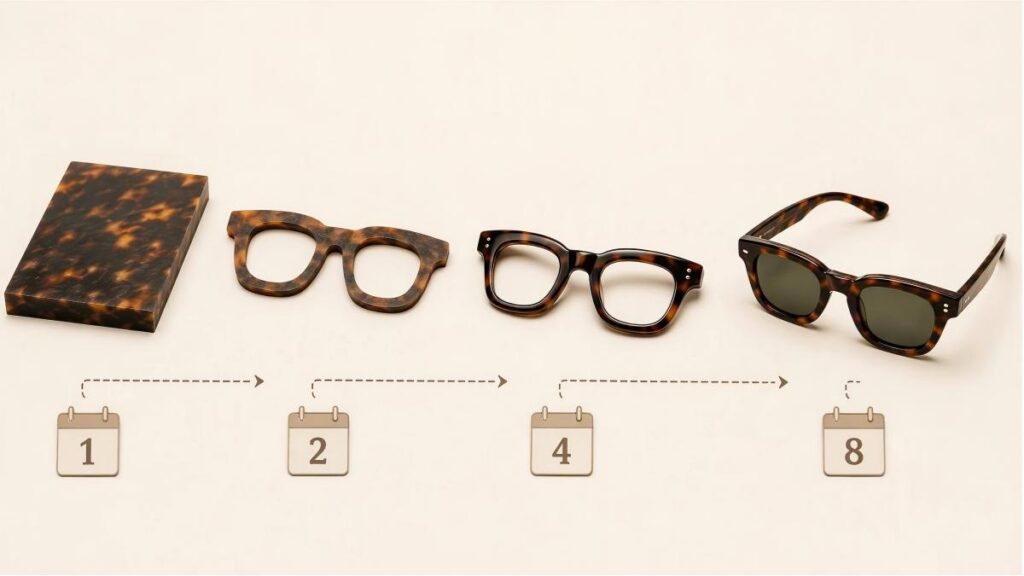
A full OEM acetate eyewear project — custom mold, new design, exclusive frame — takes 6-8 weeks from design approval to finished product. Every stage has a fixed minimum duration that cannot be compressed without compromising quality. Understanding this timeline helps you plan your collection launch, budget accurately, and avoid the most common scheduling mistake: expecting custom molds to deliver as fast as stock frame customization.
This article maps the complete acetate frame production timeline, stage by stage, with realistic durations and the consequences of rushing each one. While this guide focuses on acetate — the most common material for full OEM development — titanium, metal, and TR90 follow similar timelines, with minor differences in polishing and assembly stages.
The Complete Timeline at a Glance
| Stage | Duration | Can It Be Rushed? | Risk of Rushing |
| 1. Material procurement | 1-2 weeks | No — suppliers have fixed lead times | Wrong material, color mismatch, production stall |
| 2. Mold machining | 1 week | No — CNC machining is physics-limited | Surface defects, dimensional errors |
| 3. Prototype and sample | 1-2 weeks | Partially — hand-finishing can be prioritized | Incomplete QC, missed fit issues |
| 4. Mass production | 2-3 weeks | No — each station has minimum cycle time | QC shortcuts, inconsistent finish |
| 5. Final QC and packing | 3-5 days | No — 100% inspection takes time | Defective frames shipped to customers |
| Total | 6-8 weeks |
Stage 1: Material Procurement (Week 1-2)
What happens: Once the design is locked and molds are commissioned, the factory orders materials:
- Acetate sheets in your specified colors, patterns, and supplier (Mazzucchelli/Jimei/Jinyu)
- Lenses in your specified type, coating, and brand (Zeiss/Essilor/HOYA/CHEMI)
- Hardware — hinges, screws, temple cores, nose pads
- Packaging materials — cases, cloths, boxes, hangtags
Why it takes 1-2 weeks:
- Mazzucchelli acetate ships from Italy — 1 week transit + customs clearance
- Custom lens orders from Zeiss or Essilor have their own lead times
- Custom packaging (rigid boxes, branded cases) often takes 2-3 weeks — order these before production starts
What you should do during this stage: Approve pre-production samples from the previous mold development phase. Material procurement can run in parallel with sampling — it does not need to be sequential.
Stage 2: Mold Machining (Week 2-3)
What happens: The CAD files are loaded into CNC machining centers. Steel blocks are cut into frame front molds, temple molds, and hardware recess molds.
Why it takes 1 week: CNC machining of hardened tool steel is slow by design. A ball-nose end mill tracing a frame front cavity at 0.05mm step intervals takes hours per mold. Rushing this stage means larger step intervals and rougher mold surfaces — defects that transfer to every frame produced.
What you should do during this stage: Nothing. This is a factory-internal process. Use this week to finalize your packaging design, prepare your website product pages, and plan your launch marketing.
Stage 3: Prototype and Pre-Production Sample (Week 3-5)
What happens:
- Trial pressings produce the first frame blanks from the new molds
- Senior craftsman hand-finishes the prototype
- You receive the prototype for evaluation
- Revisions (if needed) — mold adjustment or re-machining
- Pre-production batch (5-10 pieces) produced for final QC confirmation
Why it takes 1-2 weeks: Hand-finishing a first prototype takes a full day. Shipping to you takes 3-5 days (express). Your evaluation takes 1-2 days. Revisions take 2-3 days. Second prototype confirmation takes another day.
What you should do during this stage: Evaluate the prototype immediately upon receipt. Delaying your feedback by 3 days adds 3 days to the timeline. Approve or request revisions within 48 hours.
Stage 4: Mass Production (Week 5-7)
What happens: The full production run moves through every manufacturing station. Each stage has a minimum cycle time that cannot be compressed without sacrificing quality:
| Stage | Process | What Happens | Days |
| 1 | Sheet preparation | Acetate sheets cut to frame-front blanks; laminated if multi-layer | 1-2 |
| 2 | Baking (drying) | Blanks baked in 60°C ovens to remove moisture — prevents later deformation and brightens the surface | 7-10 (parallel) |
| 3 | CNC rough cutting | Inner and outer frame contours milled from the dried blanks | 2-3 |
| 4 | Manual trimming | Craftsmen file and scrape edges to remove tool marks | 1 |
| 5 | Hot bending | Frame front heated and pressed on a curve mold, then cooled in ice water to lock the face-form curvature | 1-2 |
| 6 | Barrel polishing (rough) | Frames tumble with large wood particles — removes visible knife marks | 2-3 |
| 7 | Barrel polishing (fine) | Frames tumble with medium and fine wood particles — smooths pitting, builds initial shine | 3-5 |
| 8 | Hand polishing | Three-stage wax buffing: yellow wax (rough), purple wax (medium), titanium wax (final gloss) | 4-5 |
| 9 | Re-bending | Frame re-bent after polishing (deformation from tumbling is corrected) | 1 |
| 10 | Hinge assembly | Hinge nailed, cut, drilled, screwed into temple and frame; glue marks removed | 1-2 |
| 11 | Temple tip & end piece | Temple tips attached; end piece polished smooth | 1 |
| 12 | Lens insertion | Lenses CNC-cut to CAD dimensions and mounted | 1 |
| 13 | Final adjustment | Frame held and checked for symmetry; temple tension set | 1 |
| 14 | Inspection | Surface inspection (wear, scratches, gaps) + functional inspection (hinges, tension) | 1-2 |
| 15 | Packing | Frames wiped, temples sleeved, lenses protected, bagged, boxed | 1-2 |
Why it takes 2-3 weeks: Each station has a minimum cycle time. Hand polishing alone takes 4-5 working days for a 300-piece order. Baking takes 7-10 days but runs in parallel with other prep. These stages cannot be skipped — each frame must pass through every station in sequence.
What you should do during this stage: Confirm shipping arrangements. Book freight or courier. Prepare customs documentation if exporting to a new market.
Stage 5: Final QC and Packing (Week 7-8)
What happens:
- 100% manual inspection of every finished frame
- Lens impact testing (FDA drop ball test for US-bound orders)
- UV transmission testing for lens compliance
- Frame alignment verification
- Surface finish inspection under 3x magnification
- Cleaning, packing, and carton labeling
Why it takes 3-5 days: A QC inspector can check approximately 80-100 frames per day at full thoroughness. A 300-piece order needs 3-4 days of dedicated QC time. Rushing this stage means defective frames reach your customers.
What you should do during this stage: Arrange third-party inspection if required. Confirm shipping address and contact details. Prepare your receiving and quality check process at your end.
Factors That Extend the Timeline
| Factor | Added Time | How to Avoid |
| Design revisions after CAD approval | 1-2 weeks | Review CAD thoroughly before signing off |
| Custom acetate color development (not from standard catalog) | 2-3 weeks | Use standard colors for first production; develop custom colors for reorders |
| Mazzucchelli acetate (vs domestic) | 1-2 weeks | Account for Italy shipping + customs in your timeline |
| Complex multi-material frames | 1-2 weeks | Each material type adds separate production steps |
| Custom packaging (rigid boxes, magnetic closure) | 2-3 weeks | Order packaging before production starts |
| Third-party inspection | 1-2 days | Schedule in advance; inspector availability varies by location |
| Chinese holidays (Spring Festival, National Day) | 1-3 weeks | Check factory holiday calendar before committing to delivery dates |
The Timeline You Should Plan For
| Order Size | Realistic Timeline | Optimistic Timeline |
| 300 pcs, 1 style, standard acetate | 6 weeks | 5 weeks |
| 500 pcs, 2-3 styles, standard acetate | 7 weeks | 6 weeks |
| 300 pcs, 1 style, Mazzucchelli acetate | 8 weeks | 7 weeks |
| 500+ pcs, 3+ styles, mixed materials | 8-10 weeks | 8 weeks |
Add 2-3 weeks if your order is placed within 4 weeks of Chinese New Year (late January/early February).
FAQ
Can I split my order into two shipments?
Yes. Many brands take an air-freighted first batch (50-100 pcs for immediate launch) and sea-freighted remainder. The air batch adds 7-10 days transit; the sea batch adds 35-60 days.
What is the fastest possible OEM timeline?
4-5 weeks for a simple single-style acetate frame with domestic materials, if the factory prioritizes your order and no revisions are needed. Do not plan around this timeline.
What happens if the factory misses the deadline?
This should be covered in your purchase order. Typical terms: the factory covers air freight upgrade costs if the delay is on their side. Force majeure (material shortage, shipping disruption) is usually excluded.
Can I visit the factory during production?
Yes. We encourage it. Seeing your frames on the production line is the best way to understand the process. Week 5-6 (during mass production) is the ideal time to visit.