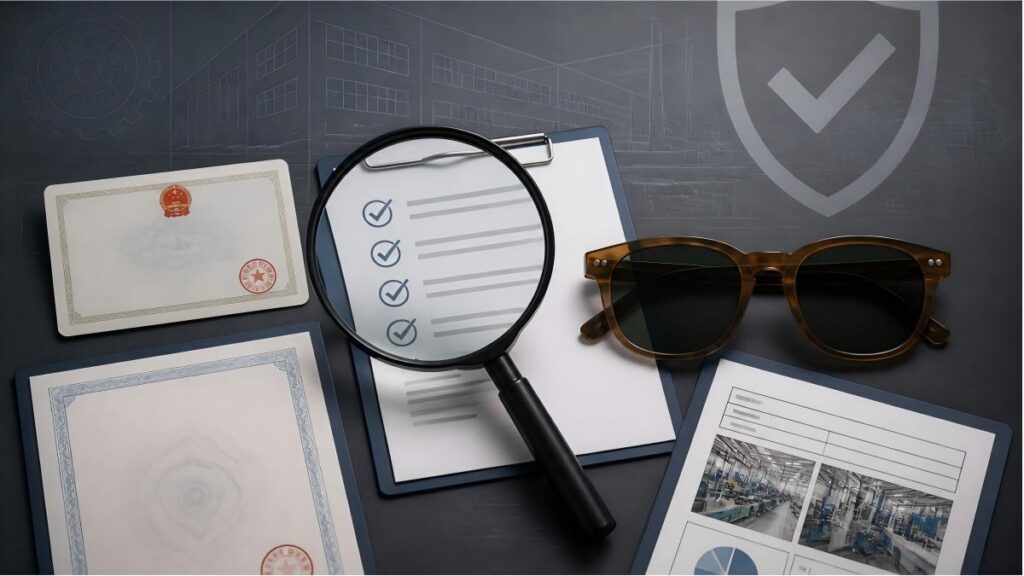
Verifying a Chinese eyewear factory takes four steps: check the business registration, validate certifications, conduct a remote or on-site audit, and verify client references. Any factory that refuses all four should be crossed off your list.
This guide shows exactly what to check at each step — written from inside a factory, so you see both the legitimate process and the red flags that trading companies cannot hide.
Step 1: Verify the Business Registration
The company that signs your contract should be the same entity that owns the factory.
What to check:
- Business license — Ask for a copy. Verify the registered address is a workshop location, not just a business office. The license in China shows the legal entity name, address, and business scope.
- Company name match — The name on the license, the contract, the invoices, and the bank account should all match. Discrepancies mean you may be dealing with a middleman billing under a different entity.
- Export license — A factory exporting directly needs import/export rights. Ask which import-export license number is on their profile.
- B2B platform profile age — Alibaba or Made-in-China membership years are a rough proxy for operational history. A 2018 profile with 15 years of claimed experience is a contradiction.
Red flags: The business license address is in a commercial complex. The contract signer cannot produce a business license. The bank account name differs from the company name on the license.
Step 2: Validate Certifications
Certifications are the second verification layer. They are market-entry requirements — and verifiable documents.
What to check:
| Certification | Market | How to Validate |
|---|---|---|
| ISO 9001 | Global | Verify the certificate number with the issuing body (e.g., TUV, SGS, BSI) |
| BSCI | Global (social compliance) | BSCI audits are searchable by audit ID in the BSCI database |
| ISO 14001 | Global (environment) | Same as ISO 9001 — verify with the issuer |
| CE / UKCA | EU / UK | Check the declaration of conformity; CE marking without a valid DoC is a red flag |
| FDA | US | FDA registration is publicly searchable on the FDA website (device establishment registration) |
| RoHS / REACH | EU | Test reports from a recognized lab (SGS, TUV, Bureau Veritas) — check the lab name and report date |
What to request:
- Copies of the certificates — not photos of a certificate wall
- The issuing body and certificate number for online verification
- Recent test reports — within 12 months — from a recognized third-party lab
- Confirmation of which certificates are in the factory’s own name
Red flags: “Certificates available” but copies never arrive. Certificates in a different company name. Test reports older than 2 years. The factory cannot explain what each certificate covers.
Step 3: Conduct an Audit (Remote or On-Site)
An audit is the highest-confidence verification. Two options:
Remote Audit (Video Call)
Ask for a live, unscripted video walkthrough:
- Production floor with running machines
- Material storage area (acetate sheets, lenses, hardware)
- QC inspection station with actual tools
- Packaging area
- A random product pulled off the line and shown close-up
A real factory can do this in 10 minutes. A trading company cannot — their “factory” is someone else’s.
On-Site Audit (Recommended for Orders Above $10,000)
For significant orders, visit or hire an inspection agency for an on-site audit. What to check in person:
| Check | What to Look For |
|---|---|
| Production floor | Machines running, workers at stations — not a showroom |
| Equipment condition | Maintenance records, no rusted or idle machines |
| Material inventory | Stock of the acetate sheets, lenses, and hardware they claim to use |
| QC area | Magnification lamps, measuring tools, inspection stations |
| Mold library | Labeled storage, your competitor’s molds (or absence of them) |
| Worker environment | BSCI-compliant conditions — safety gear, no child labor signals |
Red flags: The “factory” is a small room with sample boards. Equipment is covered in dust. The tour skips the QC area. You are shown a video instead of a live walkthrough.
Step 4: Verify Client References
Any supplier can claim 500 clients. Verifiable references are the proof layer.
What to check:
- Ask for 2-3 references from brands in your market and price segment — not just their biggest names
- Ask for a sample from a recent order, with the client’s market and product type described
- Check trade show presence: MIDO (Milan), Vision Expo (New York), CIOF (Shanghai) exhibitor directories are public
- Ask for their LinkedIn company page and check for a history of posts — a factory that posts factory floor content over years is likely real
- For Alibaba stores, check response rate, years, and review history
What counts as verification:
- A reference brand that replies to your email
- A sample product that matches the claimed order history
- An exhibitor listing at a real trade show
- A LinkedIn page with organic, dated factory content
Red flags: References are always “confidential.” The “big clients” listed cannot be found on LinkedIn or the web. No trade show participation, ever.
The Verification Scorecard
| Step | Pass (2 pts) | Partial (1 pt) | Fail (0 pts) |
|---|---|---|---|
| 1. Business registration matches | License + address + bank match | Minor discrepancies | Refuses to share |
| 2. Certifications verified | Certificates + test reports checked | Certificates only | No certificates |
| 3. Audit completed | On-site or full video audit | Brief video call | Refuses audit |
| 4. References verified | 2-3 confirmed references | One reference | All “confidential” |
Score 7-8: Proceed to sampling. Score 4-6: Verify weak points before any deposit. Score 0-3: Walk away — there are hundreds of verified factories.
Common Red Flags Summary
- Price 30% below market — Cheapest usually means lowest QC, not best value
- “Factory visit not possible” — Every real factory welcomes visitors; it is free marketing
- Deposit before sample — Legitimate factories produce samples first
- No breakdown in the quote — Hiding cost structure means hiding something
- Different company names — License, contract, invoice, and bank must match
- Website-only credibility — A beautiful website proves nothing; verifiable operations do
Frequently Asked Questions
Is it worth hiring an inspection agency?
For orders above $10,000, yes. SGS, TUV, and Bureau Veritas pre-shipment inspections cost $200-500 and cover what a video call cannot — batch consistency, finish quality, and packaging compliance.
Can I trust Alibaba’s “Verified Supplier” badge?
It is a starting point, not proof. Verification covers legal registration, not production capability or quality. Run all four steps regardless of badge status.
What if the factory asks for 50% deposit before sampling?
Unusual. Industry standard is full or partial sample payment first, then a 30-50% production deposit. A demand for a large deposit before any sample is a red flag.
How do I know if a factory is using child labor or unsafe conditions?
Check their BSCI audit status in the BSCI database. BSCI is a third-party social compliance audit. Factories with a valid BSCI audit have been inspected for worker conditions, safety, and ethical practices.
Audit our factory yourself — schedule a live video walkthrough →