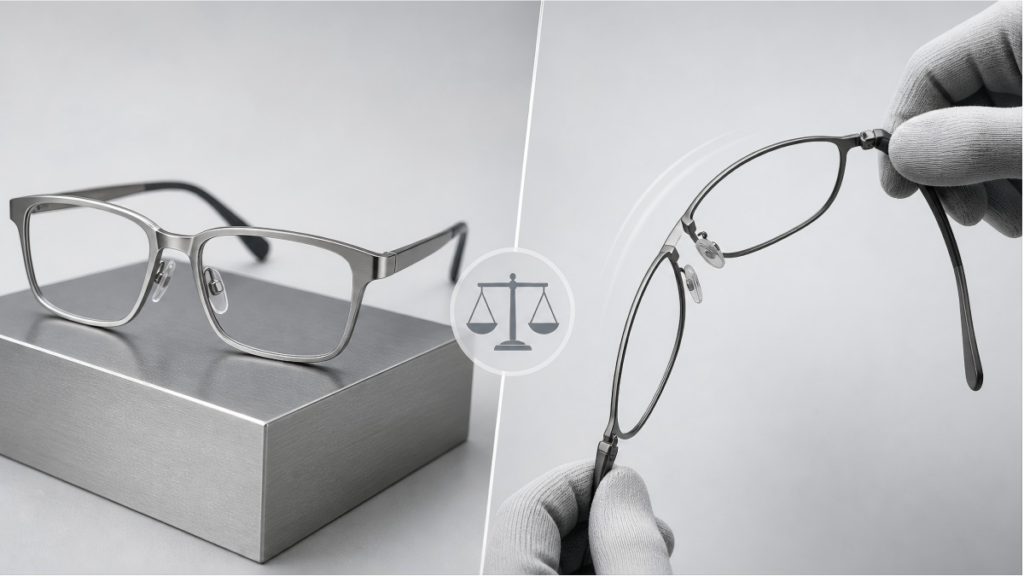
Pure titanium and beta-titanium are different materials with different properties, and choosing between them changes how your frame feels, weighs, flexes, and costs. Pure titanium is stronger and more rigid with a distinctive premium weight; beta-titanium is more flexible, lighter, and springs back to shape.
There is no universal “better” — the right choice depends on your frame design, target customer, and price point. This comparison covers the manufacturing and performance differences from a factory perspective — the properties that actually matter when the frame is on a customer’s face.
The Core Difference in One Sentence
Pure titanium = rigid and strong. Beta-titanium = flexible and springy.
Both are titanium alloys, but they are engineered for different personalities. Pure titanium frames feel substantial and hold their shape firmly; beta-titanium frames are feather-light and return to shape after bending.
Side-by-Side Comparison
| Property | Pure Titanium | Beta-Titanium |
|---|---|---|
| Common designation | CP (commercially pure) titanium | Ti-13V-11Cr-3Al or similar beta alloys |
| Typical frame weight | 10-14g | 7-10g |
| Flexibility | Rigid, minimal flex | Highly flexible, returns to shape |
| Springback | Moderate | High |
| Strength | Higher tensile strength | Lower tensile strength, higher elongation |
| Fatigue resistance | Good | Excellent (bends without breaking) |
| Hypoallergenic | Yes | Yes |
| Corrosion resistance | Excellent | Excellent |
| Cost per kg | Lower (8-12x steel) | Higher (12-18x steel) |
| Machining difficulty | Difficult | More difficult (work-hardens faster) |
| Frame styles best suited | Classic, elegant, rimless, semi-rimless | Sport, flexible temple designs, active lifestyle |
| Typical retail positioning | Premium classic | Premium performance |
What Each Material Feels Like in Practice
Pure Titanium Frames
When you pick up a pure titanium frame, you notice the weight first — not heavy, but substantial. The frame sits firmly on the face and holds its shape through daily wear.
Best uses:
- Rimless and semi-rimless frames (titanium’s rigidity holds lenses securely)
- Classic rectangular and oval optical frames
- Premium collections where “solid craftsmanship” is the brand story
- Customers who prefer a frame that feels present, not invisible
Watch out for:
- Not suitable for highly flexible designs — the material resists bending
- Adjustments require more force (though still cold-adjustable)
- On very thin profiles, rigidity can feel stiff at the temple hinge
Beta-Titanium Frames
Pick up a beta-titanium frame and you might think it is broken — the temples bend almost effortlessly and spring back. This flexibility is the feature.
Best uses:
- Sport and active lifestyle frames (impact resistance through flexibility)
- Flexible temple designs that wrap around the head
- Oversized sunglasses that need to flex without breaking
- Customers who have broken rigid frames in the past
Watch out for:
- Springback makes precise alignment harder in manufacturing
- The flexible feel can read as “cheap” to customers expecting rigidity — unless the brand communicates it as performance
- Thin beta-titanium profiles require careful machining to avoid work-hardening cracks
Manufacturing Differences (What the Factory Deals With)
Machining
| Pure Titanium | Beta-Titanium | |
|---|---|---|
| Cutting speed | Slow | Slower |
| Tool wear | High | Higher |
| Work-hardening | Present | More aggressive |
| CNC cycle time | 8-12 min/temple | 10-15 min/temple |
Welding and Joining
The joining methods are the same (silver brazing or laser welding — see our comparison guide), but beta-titanium’s higher springback makes fixturing harder: the parts resist being held in position, increasing the risk of misaligned welds.
Tolerances
Beta-titanium’s springback complicates tolerance control. A temple designed to bend at 30 degrees may spring to 27 degrees after release. Factories must compensate for springback in the design phase — a capability not every factory has.
Cost Impact
| Pure Titanium | Beta-Titanium | |
|---|---|---|
| Raw material cost | 8-12x steel | 12-18x steel |
| Machining cost | 2-3x steel | 3-4x steel |
| Scrap rate | 30-45% | 35-50% |
| Typical per-frame premium over steel | +$6-12 | +$10-18 |
| Typical retail uplift over steel | +$30-60 | +$50-90 |
The per-frame cost difference between pure and beta titanium is roughly $4-6 at manufacturing — small per unit, but significant across a full collection order.
How to Choose for Your Collection
Choose pure titanium if:
- Your brand positions as classic premium — craftsmanship, solidity, heritage
- You design rimless or semi-rimless frames
- Your target customer values a substantial, quality feel
- You are creating a capsule collection of timeless styles
Choose beta-titanium if:
- Your brand positions as performance or lifestyle — sport, travel, daily active wear
- You design flexible or sport-specific frames
- Your customers have broken rigid frames or need durability
- You want the lightest possible frame on the market
Consider mixing:
Many premium brands offer both: pure titanium for the classic optical line, beta-titanium for the sport and flexible line. This covers both customer personalities under one brand roof.
Frequently Asked Questions
Can you tell the difference by weight alone?
Usually yes. Pure titanium frames run 10-14g; beta-titanium runs 7-10g. The difference is noticeable when comparing side by side.
Is beta-titanium weaker because it’s more flexible?
No. Flexibility is not weakness. Beta-titanium’s high elongation means it bends further before breaking — which is why it survives impacts that crack rigid frames.
Are both hypoallergenic?
Yes. Both are biocompatible and do not contain nickel. Confirm the actual alloy composition with your supplier — some “titanium” frames are coated steel.
Which holds its adjustment better?
Pure titanium. Its rigidity means adjustments stay put. Beta-titanium’s springback resists adjustment — it tends to return to its original shape.
Is beta-titanium always more expensive?
Yes, at both material and manufacturing levels. Expect roughly 30-50% higher frame cost than pure titanium.