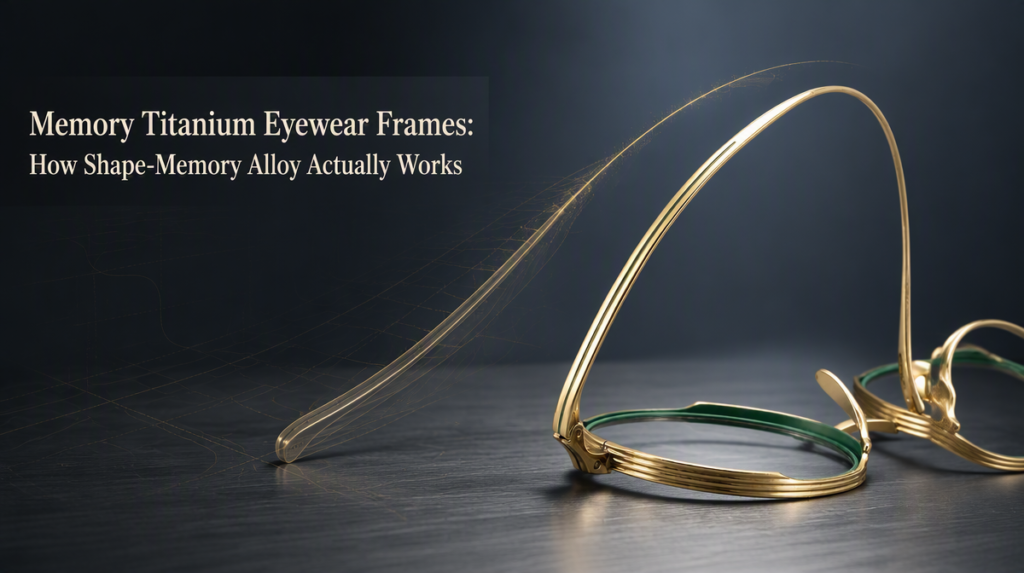
Memory titanium — often marketed as “flexible titanium” or “shape memory alloy” — is a titanium alloy that returns to its original shape after bending. It is not a gimmick: it is a genuine engineering material that solves a real problem — frames that snap when bent. But it is also not the right choice for every frame style, and there is significant marketing confusion around what “memory” actually means.
This guide explains what memory titanium really is, how it differs from regular beta-titanium, and which frame styles it suits.
What “Memory Titanium” Actually Means
There are two distinct materials marketed as “memory titanium”:
1. Nitinol (true shape memory alloy)
- An alloy of nickel and titanium (roughly 50/50)
- Two phases: martensite (flexible, low temperature) and austenite (rigid, high temperature)
- When bent in its martensite phase, it returns to its austenite (remembered) shape when released — the “memory” effect
- Used in eyeglass frames that can be twisted, bent, and always return to shape
- Caveat: Nitinol contains nickel — the frame surface must be coated or the alloy processed to prevent nickel exposure
2. Beta-titanium (marketed as “flexible titanium”)
- Not true shape memory, but highly elastic
- Bends and springs back within its elastic limit — without the true memory effect
- Contains no nickel
- Often labeled “memory titanium” in marketing
The honest distinction:
| Nitinol | Beta-titanium (marketed as memory) | |
|---|---|---|
| True memory effect | Yes | No (elasticity, not memory) |
| Nickel content | Yes | No |
| Flex performance | Extreme — can twist 180°+ | High — bends and returns within elastic limit |
| Hypoallergenic | Needs coating | Yes, inherently |
| Cost | Higher | High |
| Frame styles | Thin, flexible designs | Sport, everyday flexible frames |
How Memory Titanium Frames Feel in Practice
The demo moment
Pick up a memory titanium frame and bend a temple almost in half. Release it. It springs back to its original position — no crease, no cracking. This is the retail “wow” moment that sells the material.
Daily wear experience
- Forget-it-and-wear-it durability — the frame survives being sat on, dropped, and jammed into bags
- No adjustment needed — the frame returns to shape, so it does not deform over time like plastic
- Lightweight — comparable to standard beta-titanium
- Flexible temples — comfortable for wide faces, forgiving of daily stress
Which Frame Styles Work Best
Excellent fit for memory titanium:
| Style | Why It Works |
|---|---|
| Sport sunglasses | Impact resistance, flex without breaking |
| Kids’ frames | Survivability — kids bend everything |
| Flexible temple designs | The material’s core strength |
| Travel / everyday frames | Survives rough handling |
| Half-rim / rimless | Flexible temples reduce stress on lens mount |
Poor fit for memory titanium:
| Style | Why It Fails |
|---|---|
| Classic rigid optical frames | The material’s flexibility undermines the “solid” positioning |
| Ultra-thin dress frames | Springback fights precise alignment |
| Heavy acetate-accent frames | Material mismatch in flex behavior |
| Frames requiring precise adjustment | Memory effect resists adjustment |
The key insight: memory titanium is a durability feature, not a style. It belongs in frames where survivability matters — sport, kids, travel — not in dressy frames where rigidity is the point.
Manufacturing Considerations
Working with Nitinol
- Machining is difficult — Nitinol work-hardens aggressively, dulls tools fast
- Welding is hard — requires argon atmosphere and precise parameters
- Heat sensitivity — the memory effect is temperature-dependent; improper heat treatment destroys it
- Nickel handling — the nickel content requires surface treatment for skin contact
- Higher reject rate — expect 5-15% higher rejects than standard titanium
Working with beta-titanium (elastic, no true memory)
- Easier than Nitinol, still harder than steel
- Springback must be compensated in design
- Same argon welding requirements
The Cost Reality
| Nitinol | Beta-titanium (elastic) | |
|---|---|---|
| Raw material | 15-25x steel | 12-18x steel |
| Per-frame manufacturing premium | +$8-15 over steel | +$6-12 over steel |
| Typical retail positioning | Premium $150-300+ | Premium $120-250 |
Memory titanium is a genuine premium material — it should not be the cheapest item in your line, or the pricing will look wrong.
Frequently Asked Questions
Is memory titanium the same as beta-titanium?
Not exactly. True memory titanium (Nitinol) has a real shape memory effect. What many brands call “memory titanium” is actually beta-titanium — highly elastic but without true memory. Check the alloy spec with your supplier.
Is memory titanium safe for nickel-allergic customers?
Nitinol contains nickel, so the frame surface must be coated or the customer tested. Beta-titanium is nickel-free and inherently safe. Ask which alloy you are buying.
Does memory titanium ever lose its memory?
Over extreme cycles or heat exposure, yes. Nitinol’s memory effect can degrade after tens of thousands of bends or exposure to very high temperatures.
Can memory titanium frames be adjusted by an optician?
Within limits. The memory effect resists permanent adjustment — the frame returns to its designed shape. This is a feature (durability) and a limitation (less adjustable).