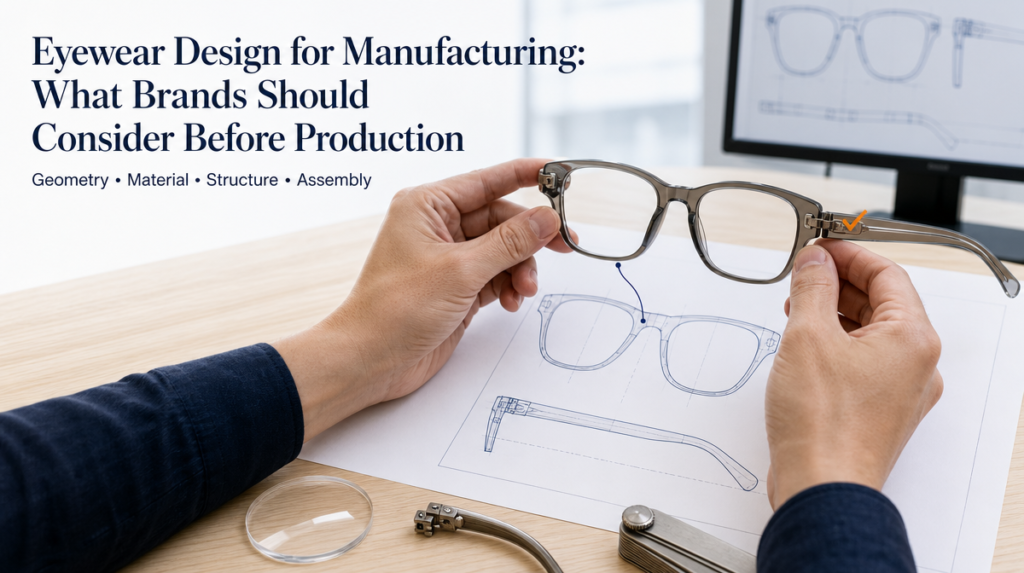
A strong eyewear design starts with a clear concept, but a successful design also needs to work in production.
For custom eyewear brands, the transition from a sketch or concept to a manufacturable frame involves more than appearance. Frame geometry, material, thickness, lens shape, hinges, finishing details, and assembly all affect whether a design can be produced efficiently and consistently.
Considering manufacturing requirements early can help reduce unnecessary revisions and make the transition from design to prototype and mass production smoother.
Why Manufacturing Should Be Considered During Eyewear Design
Some eyewear designs look excellent in a sketch or 3D model but become more complicated during actual production.
Sharp transitions, extremely thin sections, deep curves, complex 3D structures, or difficult finishing requirements may affect machining, molding, polishing, assembly, or material stability.
This does not mean a design should be simplified from the beginning. Instead, brands should understand which elements may require additional production processes and discuss them with the manufacturer before moving into prototype development.
7 Things to Consider Before Production
1. Frame Geometry
Frame geometry directly affects both appearance and manufacturability.
For example, sharp edges, deep curves, very thin sections, and complex three-dimensional shapes may require more precise machining and finishing.
For acetate frames, thickness and three-dimensional shaping are particularly important. A design may need enough material in certain areas to allow machining, polishing, and structural support.
The goal is to maintain the intended design while making sure the geometry is practical for production.
2. Material Selection
Material should be considered at an early stage because different eyewear materials have different manufacturing characteristics.
Acetate, titanium, stainless steel, and TR90 can offer different combinations of weight, flexibility, strength, finishing possibilities, and machining requirements.
For example, a design developed specifically around the visual characteristics of thick acetate may not translate directly to titanium without structural and dimensional adjustments.
The material should therefore support both the design concept and the intended production method.
3. Frame Thickness and Structural Strength
Frame thickness is not only an aesthetic decision.
Different areas of a frame may require different levels of structural support. Very thin sections can create challenges during machining, polishing, assembly, or long-term use, while excessive thickness can increase weight and change the proportions of the design.
A practical custom eyewear design needs a balance between appearance, structural requirements, material characteristics, and production feasibility.
4. Lens Shape and Lens Fit
The lens opening should be considered together with the frame structure.
Lens shape, bevel design, frame thickness, and fitting requirements all influence how the finished frame will look and perform.
More complicated lens geometries may also require greater precision during lens cutting and assembly.
For this reason, brands should not finalize the front-frame design without considering how the lens will fit into the finished construction.
5. Hinge and Temple Structure
The hinge is one of the important structural points of an eyewear frame.
Its position affects temple movement, alignment, assembly, and the overall balance of the frame.
A visually attractive temple design may still require adjustment if there is not enough space for the hinge or if the structure makes assembly difficult.
The front frame, hinge, and temple should therefore be considered as one connected system rather than separate design elements.
6. Surface Details and Finishing
Finishing can have a major influence on the final appearance of custom eyewear.
Polished edges, bevels, matte surfaces, metal details, laser engraving, logos, plating, and other decorative effects may require different production processes.
When developing a custom frame, brands should consider not only whether a finishing effect can be achieved on a sample, but also whether it can be reproduced consistently during mass production.
This is particularly important for premium eyewear where small differences in surface treatment can affect the overall appearance.
7. Assembly and Production Feasibility
A custom frame is a complete product made from multiple components.
The front frame, temples, hinges, nose pads, lenses, and decorative elements all need to work together during assembly.
A design that looks simple visually may become more complicated when precise assembly is considered.
An experienced eyewear manufacturer can review the overall structure and identify potential production issues before they become expensive changes later in the project.
From Design Concept to Prototype
Once the basic design is considered from a manufacturing perspective, the next step is to translate the concept into technical information for prototype development.
CAD plays an important role at this stage because it helps define dimensions, curves, thickness, component positions, and other structural details.
For a closer look at this stage, see CAD to Prototype: The First 14 Days of Custom Eyewear.
Clear communication between the brand and manufacturer is also important. Reference images, sketches, dimensions, preferred materials, finishing requirements, and branding details can help reduce misunderstandings during development.
For practical guidance, see How to Communicate Your Design to a Factory: References, Spec Sheets, and Common Mistakes.
When Should Mold Development Begin?
For fully custom eyewear, mold development normally comes after the design has been reviewed and the prototype direction has been confirmed.
At this stage, the manufacturer needs to translate the approved design into a structure suitable for actual production.
Mold development is not simply about creating the shape of the frame. Dimensions, material behavior, construction, and production requirements all need to be considered.
You can learn more about this stage in How Custom Eyewear Mold Development Works: From Your Sketch to Finished Frame.
Final Checklist Before Production
- Is the frame geometry suitable for the selected material?
- Are the frame thickness and structural areas practical?
- Do the lens shape and frame construction work together?
- Is the hinge structure suitable for the temple design?
- Can the surface details be reproduced consistently?
- Can all components be assembled efficiently?
- Have potential manufacturing risks been discussed with the factory?
Final Thoughts
Good eyewear design is not only about creating an attractive frame. It is about creating a design that can be sampled, refined, manufactured, and reproduced consistently.
For brands developing a fully custom eyewear collection, considering manufacturing requirements early can reduce unnecessary changes and create a smoother path from concept to finished product.
The earlier design, materials, structure, and production requirements are discussed, the easier it becomes to turn a creative idea into a practical eyewear product.
FAQ
What does design for manufacturing mean in eyewear?
Design for manufacturing means developing an eyewear design with production requirements in mind, including materials, frame structure, machining, finishing, assembly, and consistency during mass production.
Can every eyewear design be mass produced?
Not every design can be produced exactly as originally drawn. Some designs may require changes to dimensions, structure, materials, or finishing methods before mass production.
Why is material selection important for custom eyewear?
Different materials have different characteristics and production requirements. Material selection can affect frame thickness, weight, flexibility, machining, finishing, and assembly.
When should a brand discuss manufacturing feasibility with a factory?
Ideally, manufacturing feasibility should be discussed before prototype and mold development. Early review can help identify potential production issues before they become costly revisions.
Can an eyewear manufacturer help improve a design?
Yes. An experienced manufacturer can provide feedback on structure, materials, production processes, finishing, and assembly to help make a design more practical for manufacturing.