When you pay for custom mold development, you own the molds. This is not negotiable — it is the defining difference between OEM manufacturing and buying stock frames.
But ownership means nothing without understanding your rights, what happens to your molds between production runs, and how to protect your investment if you change factories. This article covers everything brands need to know about mold ownership.
What Mold Ownership Means (Legally and Practically)
When you commission custom molds from a factory, the transaction creates two things:
- Physical property — The steel and aluminum blocks that form your frame components
- Intellectual property — The design embodied in those molds
You own both. The factory is manufacturing on your behalf using your tools. They cannot:
- Produce frames from your molds for any other brand
- Show your molds or products to other clients
- Replicate your design using your CAD files
- Retain your molds if you terminate the relationship
This is typically formalized in the manufacturing agreement or purchase order. If your factory does not explicitly state that you own the molds, ask for it in writing before you pay.
Mold Storage Between Production Runs
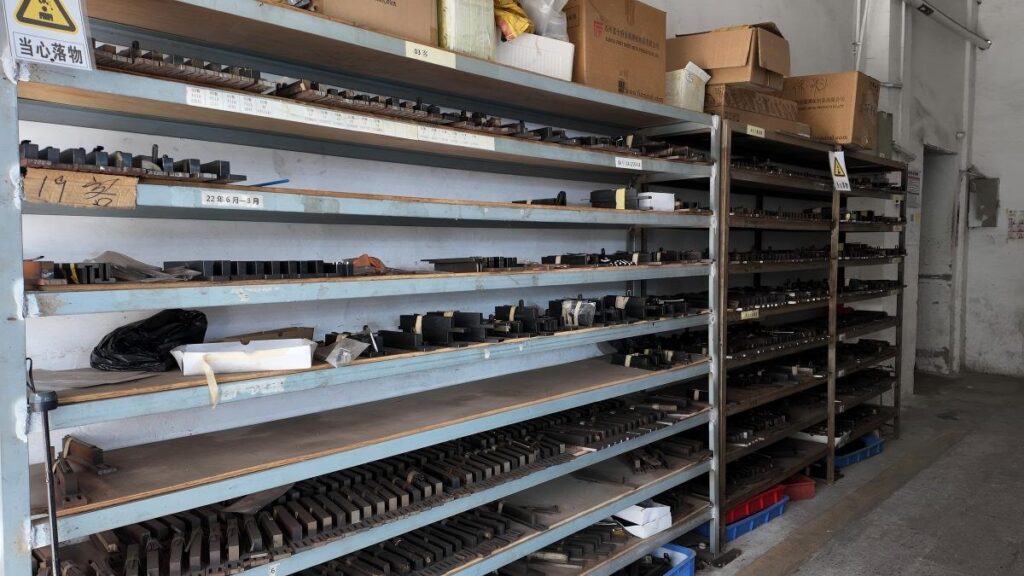
After your production run is complete, the molds are cleaned, coated with rust-preventive oil, and stored in the factory’s mold library.
What a professional mold storage setup looks like:
- Climate-controlled environment (humidity below 60% to prevent rust)
- Labeled storage racks organized by client and frame model
- Rust-preventive coating reapplied every 6 months
- Storage log recording when molds were last used and inspected
What to watch for:
- Molds stored in unsealed plastic bags in a humid warehouse corner — surface rust will damage mold cavities
- Unlabeled or poorly labeled molds — risk of loss or mix-up
- No storage log — you cannot verify your molds still exist between runs
At Mellume, our mold library stores over 2,000 client molds in a climate-controlled facility. Every mold is cataloged, photographed, and logged. Clients can request a photo of their mold at any time.
Can You Take Your Molds to Another Factory?
Yes. Your molds are your property. You can retrieve them at any time.
The process:
- Notify your current factory in writing that you are retrieving your molds
- The factory packages the molds for shipment (typically a wooden crate with foam padding — molds are heavy, 5-15kg per set)
- You arrange shipping to your new factory (or the factory ships at your cost)
- The new factory inspects the molds for damage upon arrival
- A trial pressing confirms the molds are still producing to spec
Realities to be aware of:
- Different factories use different press machines. Minor adjustments (shim thickness, press pressure) may be needed. These should take 1-2 working days, not weeks.
- The new factory will need your CAD files to verify mold dimensions against the original design. Always keep copies of your CAD files.
- Shipping steel molds internationally is expensive ($200-500 depending on weight and destination). Factor this into your factory-switching decision.
Mold Maintenance and Lifespan
Steel eyewear molds are durable but not indestructible.
| Component | Material | Expected Lifespan | Failure Mode |
|---|---|---|---|
| Frame front mold | Hardened tool steel | 15,000-25,000 pressings | Gradual cavity wear — frames become slightly oversized |
| Temple mold | Hardened tool steel | 15,000-25,000 pressings | Same as above |
| Temple tip mold | Aluminum | 5,000-8,000 pressings | Cavity wear, surface pitting |
| Hinge recess mold | Tool steel | 10,000-15,000 pressings | Edge chipping at hinge cavity |
Signs your molds need maintenance:
- Frames increasingly require hand-finishing to remove excess material (mold cavity worn)
- Surface finish on frames is rougher than earlier runs (mold surface degraded)
- Dimensions consistently measure 0.2-0.5mm over spec (cavity worn)
- Sharp edges on frame components (mold edge chipping)
Most molds can be refurbished 2-3 times before replacement is necessary. Refurbishment involves re-machining the cavity surface to remove 0.1-0.3mm of worn material. Cost: $100-200 per mold.
What Happens If the Factory Closes or Loses Your Molds?
This is rare with established factories but worth protecting against.
Prevention:
- Keep copies of your CAD files in your own storage — not just on the factory’s server
- Photograph your molds during a factory visit and keep the photos dated
- Include mold ownership and retrieval terms in your manufacturing agreement
- Request a mold inventory confirmation every 12 months
If molds are lost or damaged:
The factory should remake them at their cost. This is standard industry practice. If they refuse, your CAD files allow any other factory to recreate the molds — though you will need to pay for new mold machining.
Frequently Asked Questions
Do I own the CAD files too?
Yes. You commissioned the design work. The CAD files are your intellectual property. Always request copies in STEP or IGES format — not just screenshots.
What if I only order 300 pieces and never reorder? Can I still keep the molds?
Yes. The molds are yours regardless of order volume. Many brands store molds for years before running a second production batch.
Can I sell my molds to another brand?
Yes. If you discontinue a frame style, you can sell the molds to another brand or back to the factory. The sale transfers both physical molds and design rights.
How do I verify my molds still exist if I haven’t ordered in 2 years?
Request a dated photo of your molds from the factory’s storage area. A reputable factory will provide this within 24 hours.
What is the cost to ship molds internationally?
$200-500 for a standard 4-mold set, depending on weight and destination. Air freight (7-10 days) or sea freight (35-55 days).